

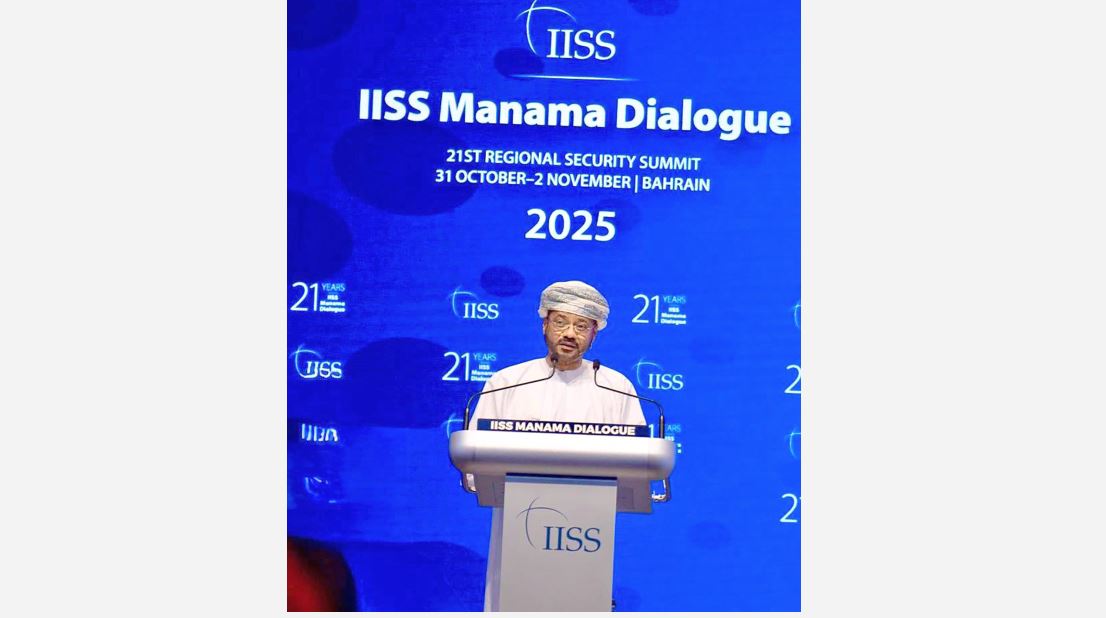
GCC states require a strong policy shift that requires inclusive dialogue with all regional states, especially with Iran, according to a leading Gulf official.
This was highlighted yesterday by Oman’s Foreign Minister Sayyid Al Busaidi, who suggests the policy of ‘isolation, containment and exclusion’ needs to end.
“As we all unite here around the conviction that stability is always fostered through dialogue and security, it cannot be achieved through policies of isolation, containment and exclusion. True security requires inclusivity.”
Mr Al Busaidi was speaking during the second plenary session of the Manama Dialogue 2025 entitled ‘Securing the Gulf: Diplomacy, Economics and Defence’.
In his candid remarks, he said since the 1979 Iranian revolution, Iran has been seen as a threat.
“It was believed that Iran sought to export its revolution and destabilise its neighbours, and that the best solution would be a policy in which Iran was isolated and contained.
“In Oman’s view, this was never a solution, as since around 1989 we observed that Iran has shown openness to rapprochement with the West and the desire to engage constructively with its neighbours.”
He said even during the invasion and occupation of Kuwait in 1990 (by Iraq), Iran demonstrated what he described as ‘considerable restraint’ .
“We saw this as a sign of its readiness to engage, and we advocated a collective and comprehensive regional security structure, that Iran might be included in,” he added.
“Looking back, I believe that if such a structure had been established, the war (in Iraq) that followed in 2003 would have been prevented, and many lives could have been saved.”
Mr Al Busaidi added that Iran continued to be viewed as a threat and an outsider in its own region.
He further added that substantial progress was made over the nuclear talks between the US and Iran, but three days before the sixth round of discussion in June this year, Israel unleashed its bombs and missiles.
“This was shameful, but unfortunately, it was not surprising,” he said. “We have long known that Israel, not Iran, is the primary source of insecurity in the region.”
The Omani Foreign Minister said despite all the attacks and assassinations, he felt that Iran responded with remarkable restraint.
“Over the years, the GCC has at best sat back and permitted the isolation of Iran. I believe this needs to change, and it needs to change now,” he said.
He added a genuine introspection was required by the six Gulf States to begin with and then start engaging with Iran, Iraq, Yemen and even others in the region.
“Failing to engage constructively and in good faith with Iran will not resolve issues like proxy wars, human suffering, or nuclear proliferation,” he believes. “An inclusive regional security framework can effectively address shared challenges, leverage collective resources, and pave the way for a more stable and prosperous future for our people.”
Also speaking during the session was Bahrain’s Foreign Minister Dr Abdullatif Al Zayani, Greece Foreign Minister Georgios Gerapetritis and European Union’s Special Representative for the Gulf Region Luigi Di Maio.
The summit ends today at The Ritz-Carlton Bahrain with plenary sessions and bilateral meetings.
&uuid=(email))