


THE Shura Council yesterday unanimously approved royal decrees establishing the Bahrain International Commercial Court (BICC) and ratifying the kingdom’s accession to several key international judicial co-operation treaties.
Parliament and Shura Council Affairs Minister Ghanim Al Buainain said the government gave utmost importance to linguistic precision and legal accuracy in international agreements.
“There are six acknowledged languages that agreements and conventions come in,” he explained.
“The translations are professional and can’t be misinterpreted. They are precise to protect rights, implementation and possible disagreements or disputes.”
Meanwhile, Justice, Islamic Affairs and Endowments Minister Nawaf Al Maawda highlighted Bahrain’s progress in judicial modernisation, pointing out that local courts were now conducting cases entirely in English – a move seen as integral to facilitating international business litigation.
The chamber’s approval of the royal decree marks Bahrain’s formal accession to four major international conventions seen as foundational for the BICC’s operation and recognition. These include:
* The 1970 Hague Convention on the Taking of Evidence Abroad in Civil or Commercial Matters, with Bahrain reserving the right to accept only requests in English and excluding provisions related to evidence collection by diplomatic or consular agents.
* The 2005 Hague Convention on Choice of Court Agreements, aimed at unifying rules on jurisdiction and recognition of foreign judgments to enhance legal certainty for cross-border trade.
* The UN Convention on International Settlement Agreements Resulting from Mediation (2018) – widely known as the Singapore Convention on Mediation – which promotes mediation as a cost-effective and efficient means of resolving international commercial disputes.
* The bilateral agreement between Bahrain and Singapore on appeals from the Bahrain International Commercial Court, signed in March 2024, which allows a flexible mechanism for international appeals while preserving Bahrain’s judicial sovereignty.
The BICC will be a specialised judicial body designed to handle complex, high-value and cross-border commercial cases arising from international trade, finance and investment.
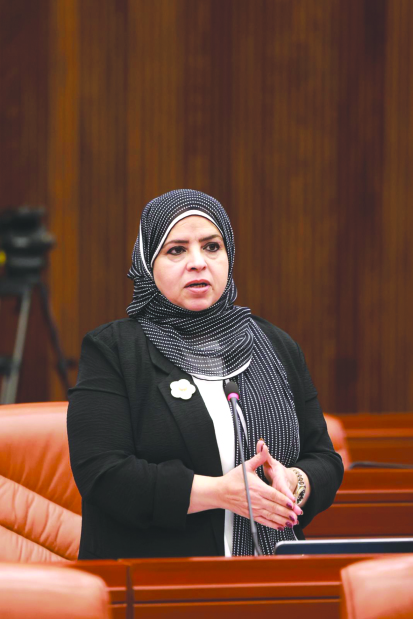
Ms Al Zayed
Shura Council legislative and legal affairs committee chairwoman Dalal Al Zayed described the new court as a “significant milestone in the kingdom’s legal evolution”, reflecting Bahrain’s leadership in building a credible and globally respected justice system.
“The new court has been designed to attract international investors by providing them with the confidence that their commercial rights will be protected within a transparent and professionally administered judicial process,” she said.
Ms Al Zayed emphasised that international judges and legal experts will be appointed to ensure the court operates with both local and global legal expertise.
She added that the initiative reflects Bahrain’s long-standing commitment to judicial independence and adherence to the rule of law, both fundamental to the country’s constitutional framework.
The committee’s report highlighted that the establishment of the BICC aligns with international best practices and mirrors advanced jurisdictions that have introduced similar mechanisms to accommodate global commerce.
It further noted that the court’s launch would bolster Bahrain’s regional competitiveness by reinforcing its reputation as a secure, predictable, and business-friendly legal environment – an achievement expected to strengthen investor confidence and stimulate economic growth.
&uuid=(email))