An ambitious plan to establish a unified hub for international conflict resolution – named the Global Justice Bay – has been revealed by a leading arbitration expert.
An educational institution, the Pearl Academy for Neutral Justice, will also be established, according to Council for International Dispute Resolution secretary-general Marike Paulsson.
Under one roof, the bay will house the Bahrain Chamber for Dispute Resolution (BCDR), Bahrain International Commercial Court (BICC), the Hague’s Permanent Court of Arbitration, the academy and more.
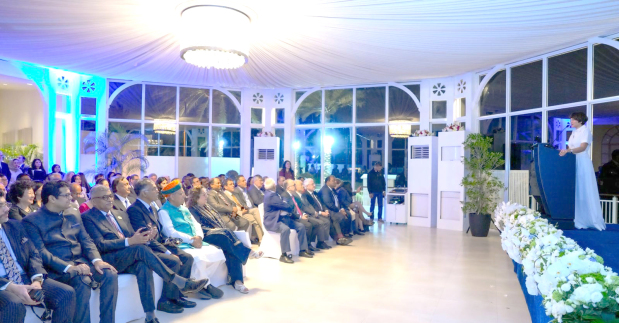
His Royal Highness Prince Salman bin Hamad Al Khalifa, Crown Prince and Prime Minister, had referred to the Global Justice Bay during his speech at the inauguration of the King Hamad Forum for Justice at Isa Cultural Centre in Juffair on Wednesday.
The announcement was made during the official launch of the BICC.
“The Global Justice Bay is a hub with institutions that provide services for resolving international disputes in trade,” Ms Paulsson, who is also the BCDR’s vice-chair, told the GDN.
“His Majesty the King had a vision for many, many years to establish a hub for international arbitration,” she said, adding it was the King’s idea to model it after the Maxwell Chambers in Singapore.
“We’re building relationships with other leading institutions in the world, to bring them all to Bahrain, to have Bahrain become a thought leader and an advocate for international law.”

Ms Paulsson
She added that a host agreement was signed with the Permanent Court of Arbitration, which administers disputes between states and investors, and state to state, based in the Peace Palace in the Hague.
Ms Paulsson described this move as ‘absolutely revolutionary’, pointing out that the court is the oldest organisation in the world that specialises in resolution of international disputes.
At the centre of the Global Justice Bay will be the BCDR, which will act as an engine for the hub, that Ms Paulsson described as the project’s ‘crown jewel’.
“Right now, we are using the premises of the BCDR, and from there, we’re building out the soft infrastructure of the hub – the laws, the treaties, institutions and people.
“The hard infrastructure is the building, which is in the beginning of the design stages,” she said, adding that more details will be revealed later.
The work to create this ambitious ecosystem will begin with ‘a worldwide roadshow’ to announce the project to the world and attract partners and individuals.
“We’ll create more partnerships with institutions, whether it’s arbitral, academic, think-tanks or other players in the world of international disputes.
“We’re thinking about how can we bring lawyers, judges, educators and quality control experts.
“But, the key to success in this space is thought leadership and education, and the Pearl Academy is to provide the home for these two pillars.
“In my view, if you want to succeed, thrive and lead, your will not get there without education.”
She explained that the academy is named after the Bahrain pearling courts.