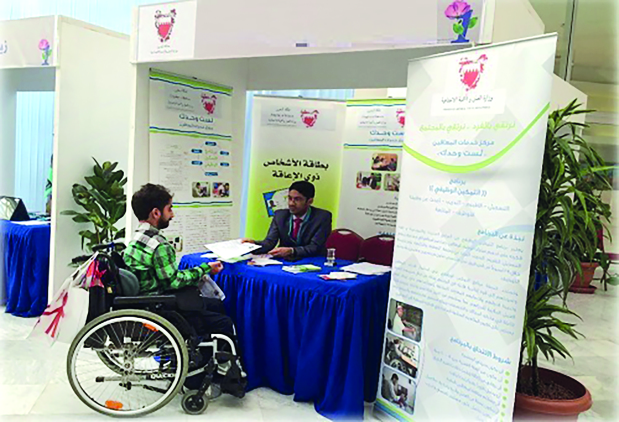
Legislators are seeking to boost employment opportunities for people with disabilities by raising their minimum job quota in large establishments from two per cent to 4pc.
A draft bill which amends certain provisions of Law No (74) of 2006 on the Care, Rehabilitation and Employment of Persons with Disabilities, is set to be debated and voted on during Tuesday’s weekly Parliament session.
The legislation was originally proposed by the Shura Council and aims to strengthen inclusion and equal opportunities in the labour market.
Under the amendment, establishments employing 50 or more workers would be required to allocate at least 4pc of their jobs to qualified people with disabilities.
The law also obliges the Labour Minister, in co-ordination with the Social Development Minister and the Civil Service Commission President, to issue a decision specifying government jobs in which the disabled will be given priority.
“The proposal reflects the spirit of equality and social solidarity enshrined in Bahrain’s Constitution,” said Parliament’s services committee chairman Mamdooh Al Saleh.
“Raising the quota is not just about numbers – it is about reaffirming the right of persons with disabilities to decent work and a dignified life.”
He added that the committee unanimously supported the bill in principle, describing it as ‘a progressive step towards integrating people with disabilities more effectively in both public and private sectors’.
The government, however, has urged MPs to reconsider the bill, arguing that its objectives were already being achieved under existing laws and policies.
In its memorandum, the Cabinet pointed to the implementation of the National Strategy for Persons with Disabilities (2023-2027) and co-operation with the private sector, which have led to ‘a higher number of job openings than the number of registered jobseekers with disabilities’.
It warned that increasing the quota to 4pc could ‘create unnecessary pressure on the state budget and conflict with the principles of the Civil Service Law’, stressing that ‘the current 2pc quota is sufficient and functional’.
According to the Labour Ministry, 325 jobseekers with disabilities were registered in 2024, most of whom had physical, hearing or intellectual disabilities.
The ministry also reported that 214 Bahrainis with disabilities were employed in the private sector in 2024, compared to 293 in 2023 and 259 in 2022.
Meanwhile, the Civil Service Commission said that 282 employees with disabilities currently work across various government entities and that 72 job titles have already been identified for persons with disabilities, in co-ordination with the Social Development Ministry.
The commission reaffirmed its commitment to integrating people with disabilities ‘within the framework of fairness and equal opportunity’, in line with the 2006 law and the 2011 UN Convention on the Rights of Persons with Disabilities.
The Social Development Ministry estimated that Bahrain is home to around 14,800 persons with disabilities as of 2024 – 58pc of whom are men. It highlighted its ongoing vocational training programmes, which run over three years and cover fields such as computer skills, hospitality, handicrafts and administrative work.
The ministry said it collaborates with 12 private centres to deliver training and rehabilitation programmes at an annual cost of BD1.2 million, with the aim of ‘building the skills and confidence necessary for employment and independent living’.
While the Bahrain Chamber opposed the proposed increase, calling the existing 2pc quota ‘adequate and balanced’, the General Federation of Bahrain Trade Unions and the Free Federation of Bahrain Trade Unions have supported the draft law.
Union representatives argued that many establishments fail to meet the current quota, and called for stricter penalties on violators to encourage compliance.
Following consultations with all concerned bodies, the services committee recommended approval of the draft law ‘in principle’.
“The inclusion of persons with disabilities is not a matter of charity but of rights,” Mr Al Saleh emphasised. “This law sends a strong message that Bahrain is committed to fairness, inclusion and equal opportunity for all citizens.”
mohammed@gdnmedia.bh