

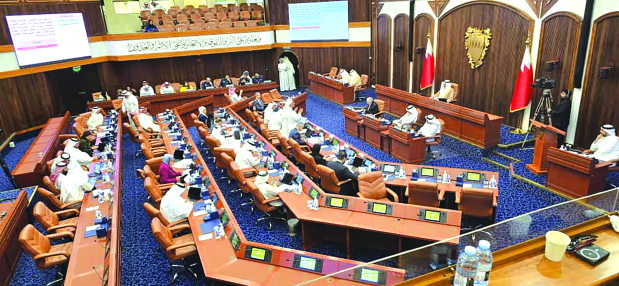
A major government-submitted bill that would overhaul key provisions of the Public Security Forces Law of 1982 is set for debate on Tuesday, marking one of the most extensive updates to Bahrain’s policing framework in decades.
The draft law proposes sweeping amendments to job titles, organisational structures, disciplinary frameworks and benefits systems within the Interior Ministry.
Following months of study, consultations with the ministry, and a review of legal and administrative impacts, the foreign affairs, defence and national security committee has unanimously recommended approving the bill in principle.
The bill replaces the term ‘Public Security Forces’ with ‘Bahrain Police’, and standardises terminology across relevant laws. It also updates a wide range of military and policing ranks, redefines the powers of senior leadership positions, and introduces new classifications such as ‘officer candidate’ in place of ‘military cadet’.
Committee chairman MP Hassan Bukhammas said the changes are essential for institutional development.
“The 1982 law has served the country for more than 40 years, but the reality of policing today is completely different,” he said. “This legislation modernises the organisational structure, aligns terminology with current national systems, and supports the Interior Ministry’s vision for a disciplined, professional and unified police force.”
Among the reforms is the inclusion of civilian staff within the Interior Ministry in certain benefits systems, including eligibility for the Police Assistance Fund, which provides support for marriage, treatment and housing needs.
“The committee found strong justification for expanding assistance mechanisms to dedicated civilian employees who play key roles in internal security,” Mr Bukhammas added. “This reflects fairness and recognises the reality of integrated teamwork inside the ministry.”
Article 43 of the bill introduces a new promotions system:
- Officer promotions will require meeting criteria set by the Interior Minister and will be issued by Royal Order, following the recommendation of the High Committee for Officers.
- Promotions for non-commissioned officers and police personnel will be made by the Chief of Police.
The legislation also permits exceptions during states of national safety or martial law.
“The objective is flexibility without compromising discipline,” Mr Bukhammas noted.
“In extraordinary circumstances, the security apparatus must be able to respond quickly.”
The bill abolishes the former ‘General Committee for Public Security Affairs’ and introduces:
The Interior Ministry Council, chaired by the minister, responsible for broad strategic policy.
A High Committee for Officers and a Committee for Personnel, each specialising in career and administrative affairs.
Article 105 grants the minister expanded authority to regulate training, administrative units, internal police academies, biometric procedures, places of detention, and service fees provided by the ministry – with some requiring Cabinet approval.
The committee also agreed to repeal multiple provisions related to promotions, secondments, transfers, external study missions and disciplinary measures – many of which have been overtaken by newer government procedures.
“This amendment is not cosmetic. It is a structural update that strengthens the police institution, enhances transparency in career progression, and aligns Bahrain’s internal security laws with international best practices,” said Mr Bukhammas.
mohammed@gdnmedia.bh
&uuid=(email))