

SINCE its founding in 1865, Zenith has been relentless to capture the essence of time with unrivalled precision. This quest goes far beyond mere technique – it reflects a philosophy, an unwavering determination to elevate the art of chronometry to unprecedented levels of excellence.
The chronometry competitions organised by observatories played a key role in this quest. From 1897, Zenith took part in these prestigious competitions, which were true proving grounds where the best watchmakers at the time competed to demonstrate their technical and scientific mastery. With 2,333 chronometry awards to its name, including several absolute records, Zenith established itself as the most decorated watchmaking Maison in history.
The Maison and its founder, Georges Favre-Jacot, proved to the world the value of their pioneering manufacturing system and their quest for the ‘perfect watch’.
As a testament to this success, among the five precision regulators used by the Neuchâtel Observatory to set the reference time, two bore the Zenith name – a rare distinction, as the manufacturer was the only representative of industrial watchmaking entrusted with keeping the exact time.
The mid-20th century marked the golden age of chronometry competitions, and Zenith reaffirmed its supremacy with the development of the Calibre 135-O, a movement especially designed for these events. With 235 awards to itself, this calibre became a global benchmark. Between 1950 and 1954, it set an all-time record: five consecutive first prizes in the wristwatch category at the Neuchâtel Observatory – an unparalleled feat.
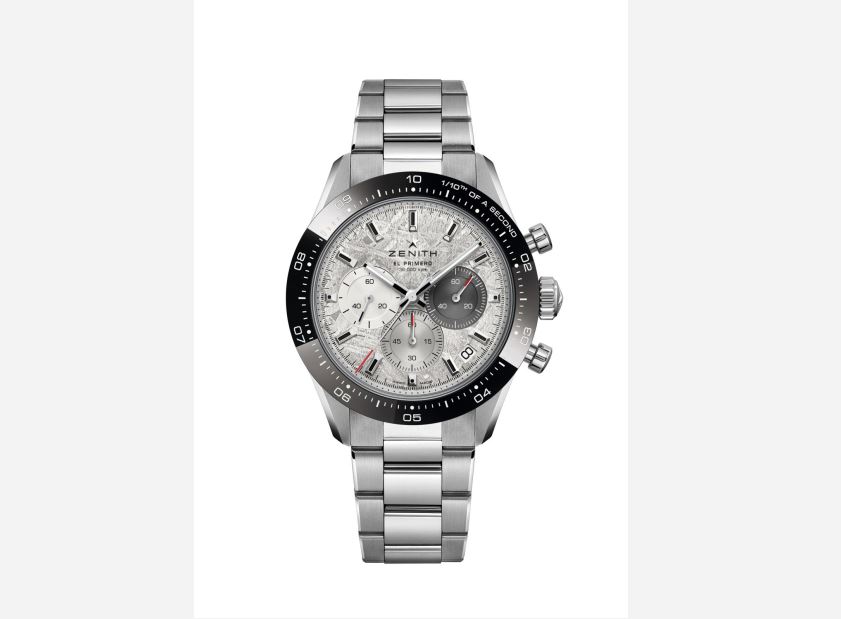
In the 1960s, Zenith took on the major new challenge of designing the very first automatic chronograph. True to its pioneering spirit, the Maison aimed for technical excellence with an integrated automatic chronograph movement – the finest of its generation and with a high frequency. The result, unveiled on January 10, 1969, was the legendary El Primero calibre, oscillating at 36,000 vibrations per hour and capable of measuring a 10th of a second. This masterpiece marked a turning point in the history of watchmaking.
More than 50 years after its creation, the El Primero remains an icon among chronograph movements, renowned for its precision and durability. But behind this success lies a heroic chapter – the story of Charles Vermot, a visionary watchmaker.
In the 1970s, as the quartz crisis shook the Swiss watch industry, Zenith had to temporarily suspend production of the El Primero. Unwilling to let this treasure disappear, Charles Vermot secretly hid all the tools and plans needed for its creation in the manufacturer’s attic for several months, in the hope of reviving it one day. A decade later, his courageous act allowed Zenith to relaunch production of this legendary calibre, which was chosen by Rolex in 1988 to power its automatic Daytona models for many years, sealing the fate of a movement that had become legendary.
In 2019, Zenith reinvented the El Primero with a major breakthrough: the El Primero 3600 calibre, which fully harnesses its high frequency. The chronograph hand now completes a full revolution in 10 seconds, providing a direct and precise reading of a 10th of a second.
The Zenith collection can be found in Hall 6 at the BJC Pavilion.
&uuid=(email))