

WALL Street wobbled and the dollar ceded ground while gold hit a new high yesterday as the Trump administration’s threat to indict Federal Reserve Chair Jerome Powell renewed questions about the future independence of the world’s most influential central bank.
Powell delivered an unusually full-throated rejection of the Department of Justice’s service of grand jury subpoenas, adding to what Morgan Stanley analysts called a “cacophony of market-moving events” to start what is only the second full week of 2026.
News that Trump was considering military action after a crackdown on protests in Iran added further potential tension following the capture of Venezuela’s Nicolas Maduro and suggestion the US could try to acquire Greenland.
Stocks slipped, with the benchmark S&P 500 down 0.1 per cent, the Dow Jones Industrial Average 0.56pc lower, and the Nasdaq Composite shedding 0.04pc.
The dollar index, measured against a basket of major currencies, fell 0.4pc to 98.83, with the euro up 0.33pc at $1.1676.
“The point is that the central bank’s response function is likely to change fundamentally and in the long term if the White House succeeds” in gaining control of monetary policy, said Thu Lan Nguyen, head of forex and commodity research at Commerzbank, after flagging that the Fed is already in a rate-cutting cycle and this scenario becomes relevant only if inflation risks rise.
“However, as the foreign exchange market is forward-looking, this already justifies a higher US dollar risk premium today,” she added.
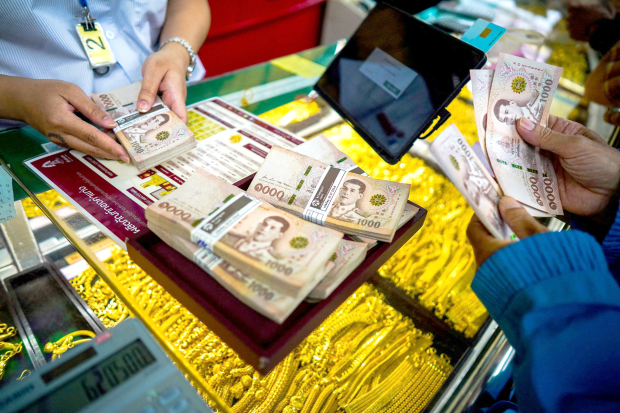
Gold enjoyed its safe-haven status and rose 2.34pc to $4,615.29 an ounce. Silver also rose.
Oil prices fell slightly after Iran said it had “total control” of the situation following a weekend of violence. Traders also factored in the prospect of further supply potentially coming from Venezuela into a market already likely to be over-supplied.
US crude dipped 0.42pc to $58.89 a barrel and Brent fell 0.21pc to $63.22 per barrel. Both benchmarks had risen last week as the crackdown in Iran tightened.
Stock in lenders and credit card firms fell harder than other sectors, after Trump’s call on Friday for a one-year cap on credit card interest rates at 10pc starting on January 20.
Citigroup fell more than 3pc. Bank of America fell around 1pc, JPMorgan Chase 1.6pc and US Bancorp more than 2pc. Finance firms Synchrony Financial and Capital One fell hard but recovered slightly to be quoted both down over 6pc.
“Based on very preliminary calculations, Citi would have the highest hit and next US Bancorp,” JPMorgan analysts said in a note, explaining that US Bancorp “has credit card loans with higher rates, implying that it has more subprime customers”.
Closely watched developments this week include US inflation data, trade figures from China and a slew of US earnings beginning with JPMorgan and BNY on Tuesday.
The dramatic escalation in the fight between Powell and Trump, which dates back to the banker’s first years as chair in 2018, will likely stay front and centre.
“Trump is pulling at the loose threads of central bank independence,” said Andrew Lilley, chief rates strategist at Barrenjoey, an investment bank based in Sydney.
“Investors won’t be happy about it, but it shows actually Trump has no other levers to pull. The cash rate will stay what the majority of the FOMC wants them to be.”
Deutsche Bank analysts totted up the various factors markets will have to weigh. “(R)emarkable stuff and all in all plenty of opportunities for big headlines over the coming days,” they said in a note.
&uuid=(email))