

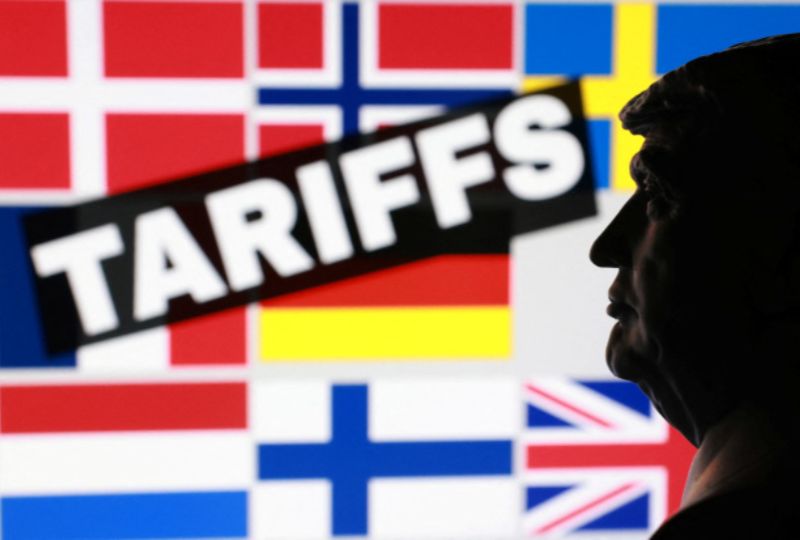
MAJOR European Union states decried US President Donald Trump’s tariff threats against European allies over Greenland as blackmail yesterday, as France proposed responding with a range of previously untested economic countermeasures.
Trump vowed on Saturday to implement a wave of increasing tariffs on EU members Denmark, Sweden, France, Germany, the Netherlands and Finland, along with Britain and Norway, until the US is allowed to buy Greenland.
All eight countries, already subject to US tariffs of 10 per cent and 15pc, have sent small numbers of military personnel to Greenland, as a row with the US over the future of Denmark’s vast Arctic island escalates.
“Tariff threats undermine transatlantic relations and risk a dangerous downward spiral,” the eight-nations said in a joint statement published yesterday. They said the Danish exercise was designed to strengthen Arctic security and posed no threat to anyone. They said they were ready to engage in dialogue, based on principles of sovereignty and territorial integrity.
Danish Prime Minister Mette Frederiksen said in a written statement that she was pleased with the consistent messages from the rest of the continent, adding: “Europe will not be blackmailed”, a view echoed by Germany’s finance minister and Sweden’s prime minister.
“It’s blackmail what he’s doing,” Dutch Foreign Minister David van Weel said on Dutch television of Trump’s threat.
A source close to French President Emmanuel Macron said he was pushing for activation of the ‘Anti-Coercion Instrument’, which could limit access to public tenders, investments or banking activity or restrict trade in services, in which the US has a surplus with the bloc, including digital services.
Bernd Lange, the German Social Democrat who chairs the European Parliament’s trade committee, and Valerie Hayer, head of the centrist Renew Europe group, echoed Macron’s call, as did Germany’s engineering association.
Meanwhile, Irish Prime Minister Micheal Martin said that while there should be no doubt that the EU would retaliate, it was “a bit premature” to activate the anti-coercion instrument.
And Italian Prime Minister Giorgia Meloni, who is closer to the US President than some other EU leaders, described the tariff threat on Sunday as “a mistake”, adding she had spoken to Trump a few hours earlier and told him what she thought.
Asked how Britain would respond to new tariffs, Culture Secretary Lisa Nandy said allies needed to work with the United States to resolve the dispute.
“Our position on Greenland is non-negotiable ... It is in our collective interest to work together and not to start a war of words,” she told Sky News yesterday.
&uuid=(email))