

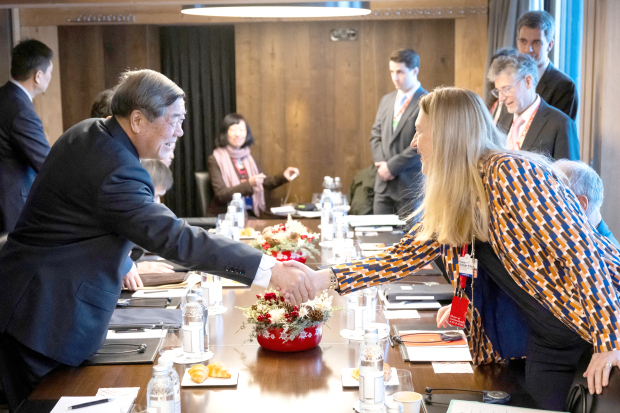
China never deliberately pursued a trade surplus and is willing to be “the world’s market”, Vice Premier He Lifeng told the World Economic Forum yesterday, after the manufacturing giant logged a record surplus that will further unnerve its trade partners.
China is willing to leverage its “mega-sized market” and “more vigorously” expand imports, He said at the WEF’s annual meeting in the Swiss ski resort Davos.
“We are not only willing to be the world’s factory, but also, more eagerly, to be the world’s market,” He said. Last year, resilient demand for goods made in China helped the world’s second-largest economy weather challenges from US President Donald Trump’s erratic trade policies and slow sales at home.
However, China’s reliance on exports has created endemic production overcapacity and exposed it to potential pushback from countries seeking to protect their own manufacturing sectors.
Vice Premier He is leading a Chinese government delegation in Davos, where various heads of state, including Trump, and top tech and financial executives are among some 2,900 delegates. He, the third-highest-ranking Chinese official to attend Davos since President Xi Jinping’s visit in 2017, will also host a reception with global business leaders, a source told Reuters.
Beijing’s delegation is expected to present China as a reliable trade and investment partner at a time when Washington’s erratic and coercive tariff policies have unsettled both rivals and allies.
“The unilateral practices and trade agreements of some countries clearly violated the basic principles and rules of the World Trade Organisation and seriously undermined the international economic and trade order,” He said without naming any nation.
“China is all countries’ trading partner rather than an adversary, and China’s development is an opportunity rather than a threat to global economic development,” He said in his address. In many cases, “China wants to buy but the other party does not want to sell,” He said, mentioning “pan-securitisation”, a term Beijing often uses to describe trade curbs imposed by the US and its allies because of national security concerns.
The message of openness to imports and foreign businesses echoed Beijing’s Davos addresses in recent years, a senior executive of an international for-profit organisation told Reuters.
“It’s not new. We care about the measures that follow.”
Canada’s Prime Minister Mark Carney last week called China “more predictable” than the US and, in a break with Washington, slashed tariffs on Chinese electric vehicles in exchange for lower duties on Canadian canola.
Trump, who revived his claim to the semi-autonomous Danish territory of Greenland, forcing Nato members and European countries to scramble for a response, is set to speak at the forum today.
China’s economy hit the official growth target of ‘around 5 per cent’ in 2025, but economic expansion slowed to a three-year low in the fourth quarter, raising questions about the sustainability of its export-led model.
As Chinese exporters diversify beyond the US market because of tariffs, they are also increasingly running into protectionist measures as more countries erect trade barriers to shield domestic industries.
In his address, He defended China’s development model, saying that its success relied on reform and opening up as well as innovation, not government subsidies. Trading partners, including the EU, have accused Beijing of using subsidies to give its industries, such as the EV sector, an unfair advantage.
China is prioritising expanding domestic demand this year, He said, inviting global companies to “seize the opportunities.”
Nicolas Heuze, CEO of France-based renewable energy company Sweetech, told Reuters his company might consider investing in China given Beijing’s message.
“The question is, can we? Can we go there and protect our intellectual property and protect our investments and how do you communicate culturally?”
n Meanwhile, Abu Dhabi state investment firm Mubadala is looking for opportunities in artificial intelligence and robotics, Group CEO Khaldoon Khalifa Al Mubarak said yesterday, focusing on technologies expected to reshape industrial activity.
&uuid=(email))