

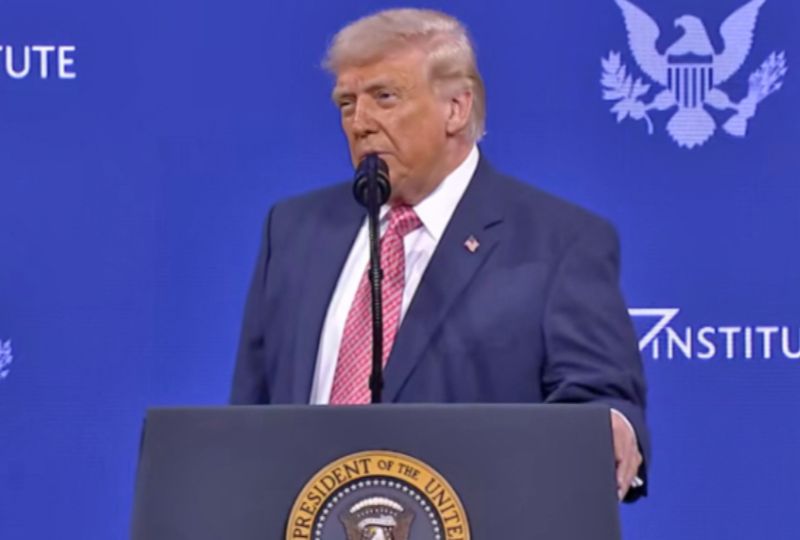
US President Donald Trump yesterday insisted Iran must open up the Strait of Hormuz to oil traffic to make a peace deal – and dubbed the crucial waterway the ‘Strait of Trump’.
Trump, who has renamed several buildings in Washington after himself during his second term, said his comment was a ‘mistake’ but then added that “there’s no accidents with me”.
Repeating his claims that Tehran is ready to make a deal despite its denials, the US leader said that talks were underway to negotiate an end to the month-long conflict.
Trump added that Iran was ‘on the run’ and reiterated assertions that Tehran’s leadership, navy, air force and nuclear programme had all suffered significant damage.
“We’re negotiating now, and it would be great if we could do something, but they have to open it up,” Trump told a Saudi-backed FII Priority investment forum in Miami.
“They have to open up the Strait of Trump – I mean Hormuz. Excuse me, I’m so sorry. Such a terrible mistake.”
Trump said the media would pounce upon the comment, but then added “there’s no accidents with me, not too many”.
He also talked about how he had ordered the renaming of the Gulf of Mexico as the ‘Gulf of America’ shortly after returning to power.
During a cabinet meeting on Thursday, Trump said it was ‘an option’ to take control of Iran’s oil as the US has effectively done with Venezuela – despite the fact that the war is still raging.
The Strait of Hormuz was open to international shipping before the conflict, but the narrow waterway has since ground to a standstill, leading to a surge in global energy prices.
Earlier yesterday, US Secretary of State Marco Rubio voiced alarm that Iran would seek to establish a permanent “tolling system” for vessels in the strait, through which one fifth of global oil normally transits.
Rubio told reporters after meeting G7 counterparts in France that the US expects its military operations against Iran to conclude within weeks, not months, and Washington can meet all its objectives without using ground troops.
He acknowledged it was deploying some to the region “to give the president maximum optionality and maximum opportunity to adjust the contingencies, should they emerge.”
Rubio said European and Asian countries that benefit from trade through the waterway should contribute to efforts to secure free passage, downplaying US dependence on the trade.
Washington has dispatched two contingents of thousands of Marines to the region, the first of which is due to arrive around the end of March aboard a huge amphibious assault ship.
The Pentagon is also expected to deploy thousands of elite airborne soldiers.
&uuid=(email))