

Logistics firms in Bahrain and across the region are adapting to the closure of the Strait of Hormuz with longer routes for their vessels, shifting cargo to Red Sea ports and increasing air freight use for high-value and perishable items.
Since the conflict between US-Israel and Iran started on February 28, the Strait of Hormuz, which handles 20 per cent of global oil trade, has been effectively closed, with traffic dipping from 1,900 vessels last year to around 100 during comparable periods.
According to the Bahrain Centre for Strategic, International and Energy Studies (Derasat), this closure, combined with the ongoing temporary closure of the kingdom’s airspace, has ‘significantly disrupted Bahrain’s supply chains by limiting sea access to Gulf ports, increasing transit times and costs for imports and exports, and making air cargo processes more complicated’.
“Land borders and alternative overland routes, facilitated by Saudi Arabia, have helped mitigate some effects, keeping essential flows moving with strategic reserves covering months,” Derasat economic studies programme senior analyst Ali Faqeeh told the GDN.
“Most affected sectors include energy, petrochemicals and plastics, agriculture (due to fertiliser shipping disruptions), manufacturing, and certain consumer goods with longer lead times.”
Bapco Energies and Alba have declared force majeure in the past month due to ongoing Iranian attacks, noting that they might be unable to meet contractual obligations due to operational disruptions.
As the attacks continue, Derasat has been conducting research on these supply chains and food security in Bahrain’s import-dependent economy.
Although food and medicine are facing pressure, they have remained relatively stable due to diversification and reserves.
Sectors like local services, domestic agriculture and fisheries, and overland-linked trade have been largely unaffected or even gotten a boost during this period.
A number of logistics and shipping firms have adapted by rerouting vessels around the Cape of Good Hope, which has added anywhere from 10 to more than 14 days to their shipping times.
Other strategies have included shifting cargo to Red Sea ports for onward overland or feeder transport, staging goods in hubs like India and Pakistan, and increasing use of air freight for high-value or perishable items, despite airspace constraints.
“Saudi Red Sea ports, particularly Jeddah, handling containers, dry bulk, food and general cargo, with expectations of up to 50pc surge, and Yanbu, a key for oil via pipelines which transfers more than seven million barrels a day have emerged as particularly important alternatives, alongside others like Fujairah and Khor Fakkan,” Mr Faqeeh added.
“New services and Saudi initiatives have supported these shifts.”
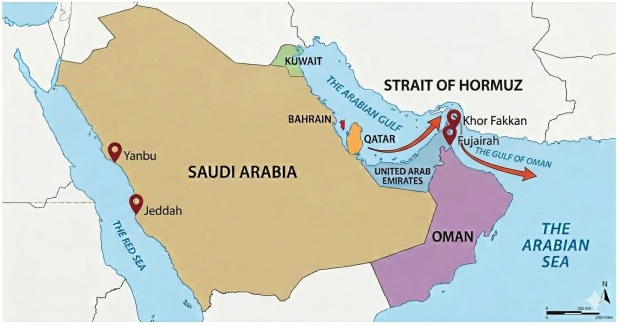
Yanbu, Jeddah, Khor Fakkan and Fujairah have emerged as alternative ports to circumvent the closure of the Strait of Hormuz
The GDN reported last week that the Saudi Ports Authority (Mawani) launched a maritime link with Bahrain through the Gulf Shuttle shipping service operated by MSC, from King Abdulaziz Port in Dammam to Khalifa Bin Salman Port.
The route has a capacity of up to 3,000 standard containers.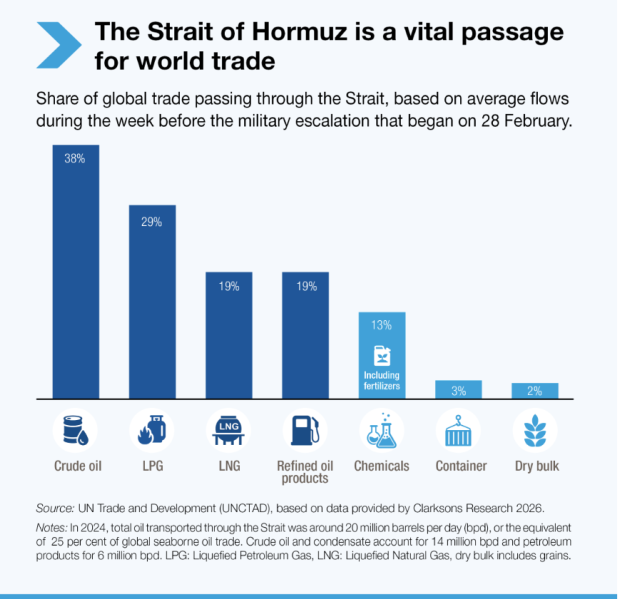
The share of global trade passing through the strategic chokepoint
Combined with streamlined customs regulations, this development will provide shorter and more reliable direct sea links between both countries, facilitating faster feeder services, reducing dependence on disrupted Arabian Gulf routes, and speeding up overland transfers from Red Sea ports, according to Mr Faqeeh.
Saudi’s broader Logistics Routes Initiative involving road networks, eased borders, and new shipping services, regional connectivity is being improved while delays for essentials like food and medicine are being cut.
According to Derasat, this will build resilience against Hormuz-related bottlenecks.
The new routes come with their own risks, including prolonged transit times leading to delays and spoilage of perishables, sharply higher freight and insurance costs (war-risk premiums), physical threats like mines, drones, or attacks, and operational issues such as port congestion or capacity limits.
The routes also remain highly susceptible to geopolitical tensions, as spillover like potential renewed disruptions in the Red Sea and Bab al-Mandab via Iranian proxies or escalations can quickly affect insurance availability, naval escorts, and overall confidence in maritime security, amplifying volatility across energy, food, and industrial chains, according to Mr Faqeeh.
To further mitigate risk, Mr Faqeeh recommended diversifying import sources and routes beyond traditional maritime chokepoints, investing in domestic food and agricultural production, while adopting technology for efficiency and boosting strategic reserves.
GCC-level coordination on logistics, and public-private partnerships for alternative infrastructure like rail or road corridors could also help Bahrain and the region be better prepared in the long-term.
“Regular scenario planning on supply chain risks, as Derasat emphasises, can support proactive adjustments to maintain economic stability in the long run and during difficult times,” he added.
naman@gdnmedia.bh
&uuid=(email))