

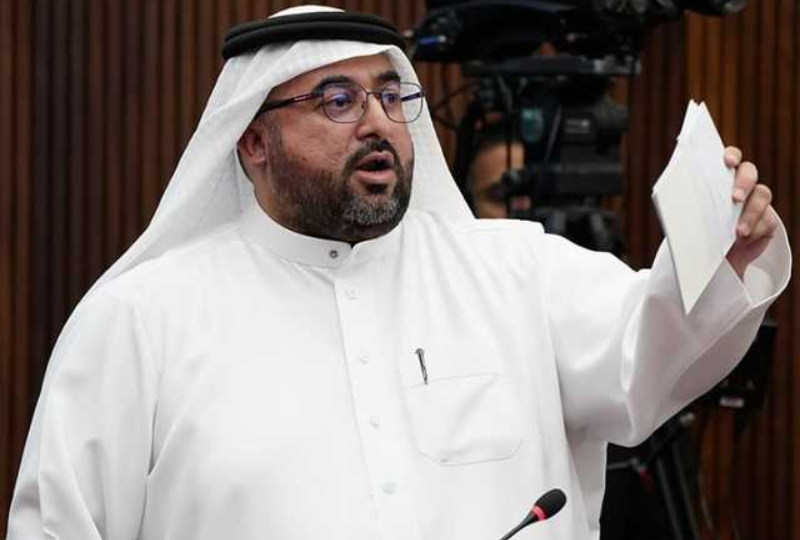
Legislators are seeking to regulate instalment sales after a recent fraud case involving smartphone contracts exposed what they claim are ‘serious gaps’ in consumer protection.
A draft legislation, spearheaded by MP Hamad Al Doy and backed by four other MPs, was approved for urgent referral to the financial and economic affairs committee during the Parliament session yesterday.
Mr Al Doy said the proposal was prompted by complaints from citizens who fell victim to ambiguous contracts, inflated prices and misleading instalment terms.
“What we are seeing in the market is exploitation under the guise of instalment sales. Citizens are being lured by easy monthly payments without knowing the real cost they are committing to,” he said.
The urgency of the proposal follows an announcement by the Interior Ministry that a 53-year-old man had been arrested by the Southern Governorate Police Directorate over alleged fraudulent smartphone sales through dubious instalment plans.
According to the ministry, the suspect allegedly made customers sign contracts before later falsifying them by inserting inflated amounts far exceeding the actual value of the devices. The case was referred to the Public Prosecution after multiple complaints were received.
Mr Al Doy said the case was not an isolated incident, but a symptom of a wider problem in the market.
“This case clearly shows how some traders manipulate contracts after they are signed. We need a law that closes these loopholes and protects consumers from price gouging and deception,” he said.
Under the proposed law, no individual or business would be allowed to conduct instalment sales without obtaining a licence from the relevant ministry.
Anyone found practising the activity without a licence would face imprisonment for up to one year and a fine ranging between BD1,000 and BD5,000, or either of the two penalties.
The draft law also requires that a formal contract be drawn up for every instalment transaction, clearly stating the original cash price, the total instalment price, the down payment, the annual interest rate and the method used to calculate it.
“The buyer must know exactly how much they are paying above the original price and how that increase is calculated,” Mr Al Doy said. “Transparency in numbers is the key to preventing exploitation.”
The contract must also clearly specify the instalment period, number of payments, value of each instalment and due dates.
The proposal allows contracts to be drafted electronically to ensure proper documentation and traceability.
Importantly, the draft grants buyers the right to early repayment, with a reduction in the interest applied accordingly – a practice currently absent or is unclear in many instalment agreements. Another key provision prevents sellers from terminating the contract if the buyer has already paid 75 per cent of their financial obligations.
“We have seen cases where people pay most of the amount and still lose the item or face legal threats because of minor delays. This is unfair and must be addressed,” Mr Al Doy said.
He added that the law would also require clearer regulation of interest rates after ‘market practices revealed excessive price inflation that amounts to hidden interest’.
“Instalment sales should be a tool to help citizens purchase what they need, not a trap that multiplies the price beyond reason,” he said.
&uuid=(email))