

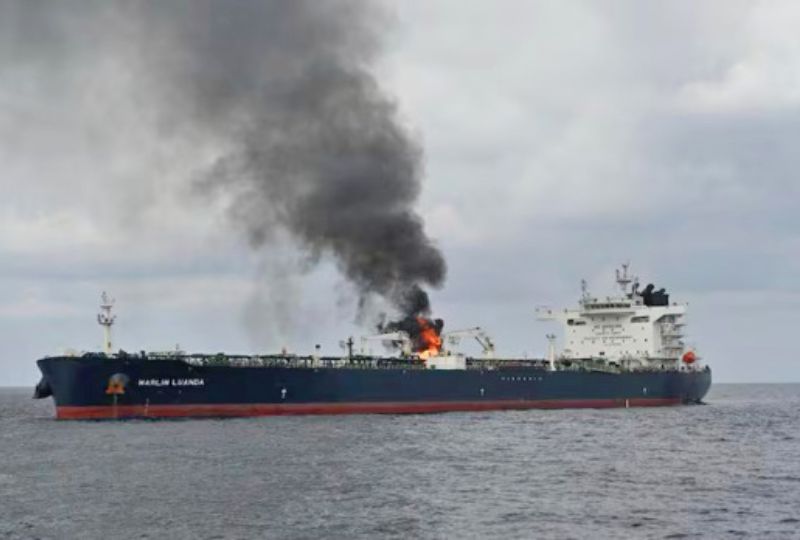
Modern tankers can take a direct hit from a drone or a missile and stay afloat thanks to the training of their crews, a UAE newspaper revealed.
Lessons learnt from the Red Sea conflagration, when more than 175 vessels were attacked during the Houthi blockade over two years, can be applied to the Arabian Gulf during the current conflict, captains told The National.
Despite highly flammable cargoes, crews familiar with the many ways of tackling flames and preventing explosions can avert costly disasters.
The Kuwaiti oil tanker Al Salmi was hit in an Iranian drone attack off Dubai yesterday, resulting in a fire that was brought under control.
The ship was heading to Qingdao, China, carrying 1.2 million barrels of Saudi crude oil and 800,000 barrels of Kuwaiti crude, according to monitoring service TankerTrackers.com.
The Strait of Hormuz carries a fifth of global oil volumes but journeys through the waterway fell to a handful a day in March.
Despite being fully loaded, the fire on board was brought under control and the ship remained afloat.
Capt Mustapha Zhehhaf said gas and oil tankers are equipped with portable and fixed firefighting systems.
For large deck fires, water, foam and powder can be sprayed from fixed points for a rapid response to the emergency, after which the crew will fight the fire, Capt Zhehhaf told The National.
When fire breaks out, there is a danger of the cargo catching light.
Fuel oil is hard to set alight but when air meets its vapour under certain conditions, it can result in an explosion, so tankers also use an inert gas system for containment.
Oxygen in cargo tanks is replaced with non-flammable gas, reducing it to a level at which it does not burn.
“Despite the crew being trained for these situations, we don’t want to witness (fires) on board at all,” said Capt Zhehhaf, a master of liquid natural gas carriers.
Another captain, Avhilash Rawat, told The National what happened when his ship, the Marlin Luanda, took a direct hit from a Houthi missile in 2024.
In the tanks were 84,147 tonnes of naphtha, a highly flammable and volatile liquid mixture of hydrocarbons used in industrial processes.
Images showed flames leaping into the night sky but the actions of the crew meant the ship did not sink.
The vessel continues to ply its trade today, under a different name.
&uuid=(email))