

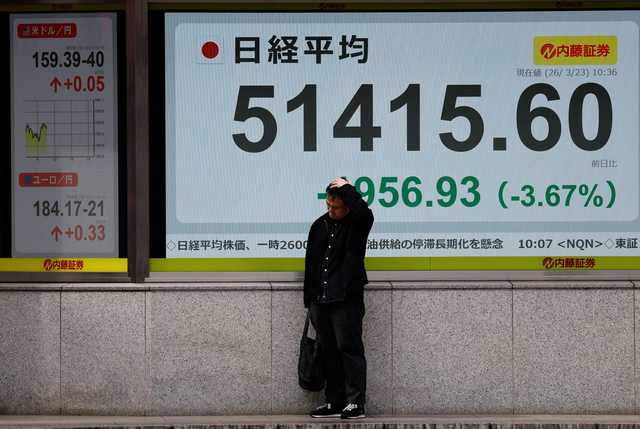
Global shares rose yesterday and Brent crude oil prices were poised for a record monthly increase, as traders came to the end of a tumultuous March dominated by the Iran war.
Markets got a lift from a Wall Street Journal report that Trump had told aides he is willing to end the military campaign even if the strait remains largely closed.
The war, which began with the US and Israel launching co-ordinated strikes against Iran on February 28, has sent shockwaves across global markets and raised the risk of a worldwide recession.
MSCI’s gauge of stocks across the globe rose 10.42 points, or 1.08 per cent, to 971.29.
“We’re in an oversold condition and then that coupled with this element of potentially encouraging news has helped to shape the bounce that we’re seeing today,” said Fiona Cincotta, senior market analyst at City Index. She cautioned, however, that the move should be treated carefully.
On Wall Street, the Dow Jones Industrial Average rose 1.21pc to 45,764.14, the S&P 500 added 1.52pc to 6,440.34 and the Nasdaq Composite climbed 2.02pc to 21,214.90.
The pan-European STOXX 600 index rose 0.91pc, and Europe’s broad FTSEurofirst 300 index gained 0.85pc.
But the STOXX 600 remained on track for its steepest monthly loss since June 2022, a break from its previous eight months of gains.
Equity markets are “taking the US administration at their word, that they’re going to end the war,” said Colin Graham, head of multi-asset strategies at Dutch asset manager Robeco.
“They haven’t moved to day-two where the Strait of Hormuz could still be closed.”
Brent crude futures were up nearly 5pc on the day at $118.38 a barrel, on track for their biggest monthly gain on record.
US West Texas Intermediate futures meanwhile fell 0.59pc to $102.27.
Oil prices have surged as a result of the war, due to Iran’s effective closure of the Strait of Hormuz, which carries about a fifth of the world’s oil and liquefied natural gas.
The average US retail price of petrol hit $4 a gallon on Monday.
The oil shock meant euro zone inflation jumped past the European Central Bank’s 2pc target in March, data showed.
Government bond yields had retreated from multi-year highs at the start of the week after rising sharply this month because of the conflict, with investors appearing to refocus on the risk of weaker growth stemming from the energy shock.
The German 2-year yield fell 0.2 basis points to 2.62pc.
“If the Strait of Hormuz remains closed for the next week or two, then I think we’ll be raising our probabilities of recession in our scenario analysis,” Robeco’s Graham said, adding that this was not yet the case.
The Japanese yen strengthened 0.35pc against the greenback to 159.14 per dollar.
Japan’s finance minister said that the government was ready to respond “on all fronts” against foreign exchange volatility, underscoring Tokyo’s alarm over the yen’s recent slide.
In commodities, spot gold rose 2.25pc to $4,612.60 an ounce.
&uuid=(email))