


Researchers are calling on policymakers and financial institutions across Bahrain to develop cryptocurrency educational initiatives targeted at women to help alleviate some of their concerns around the emerging technology.
A recent study showed that men are overwhelmingly more inclined to adopt digital assets and explore cryptocurrency markets, while women are exhibiting a more cautious and risk-averse approach.
The study – titled ‘Gender Preferences in Cryptocurrency Systems: Sentiment Analysis and Predictive Modelling in the Kingdom of Bahrain’ – was published in the peer-reviewed academic journal Veredas Do Direito.
The research was conducted by Layla Alhalwachi from Bahrain Polytechnic and Fajer Danish from Royal University for Women.
“As cryptocurrencies continue to reshape digital financial markets, understanding demographic and behavioural factors influencing cryptocurrency adoption has become increasingly important,” researchers noted, in the abstract for the study.
“The findings reveal notable gender disparities in cryptocurrency engagement and investment preferences. Male participants demonstrated higher participation levels and stronger predictive classification accuracy compared to female respondents.”
The study is based on a survey of 332 respondents conducted via a Google Form distributed by LinkedIn, WhatsApp and Facebook.
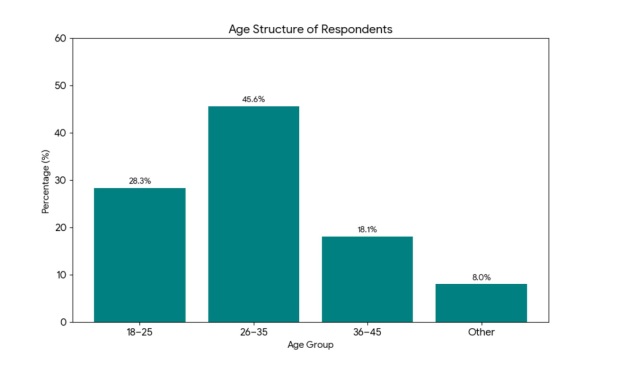
Age distribution of respondents
In total, 620 respondents answered the survey, and a sample of 332 was selected. Of the total sample size, 58.2 per cent of respondents were male, while 41.8pc identified as female.
The majority of participants fell within the 26 to 35 age bracket, comprising 45.6pc of the sample, followed by the 18-25 and 36-45 age groups at 28.3pc and 18.1pc respectively, suggesting a predominantly young adult demographic familiar with digital financial technologies.
The data indicates that 62.4pc of the participants held at least a bachelor’s degree, while 15.7pc possessed postgraduate qualifications, while the occupational profile showed that 42.3pc were employed in the technical or professional sectors.
“The results of this study align with previous research indicating that male consumers are more than twice as likely to consider cryptocurrency investments, a trend attributed to personality traits such as higher openness to experience and financial overconfidence,” researchers noted, adding that female users generally display a more cautious and risk-averse approach to digital asset adoption.
“From a practical perspective, the findings highlight the importance of developing gender-inclusive financial education programmes and fintech platforms that address the differing needs and risk perceptions of users.”
The study calls on financial institutions and policymakers to design targeted educational initiatives that address women’s specific risk perceptions and technological anxieties.
Security and transparency were identified as key factors for women, and implementing tailored financial literacy programmes and user-friendly interfaces that emphasise these can help overcome the confidence gap amongst women.
“Such initiatives are essential for transforming the cautious sentiment observed among female users into active engagement, ultimately contributing to a more balanced and resilient digital economy,” researchers noted.
Researchers also suggested that future studies explore how market volatility and regulatory developments influence sentiment and investment behavior over time, incorporating factors like socioeconomic status and caregiving responsibilities, to have a better understanding of how women and men make investment decisions related to cryptocurrency.
naman@gdnmedia.bh
Cryptocurrency is a digital or virtual currency secured by cryptography, operating on decentralised, blockchain-based networks rather than central financial authorities.
It enables secure, peer-to-peer online transactions, with value determined by market demand. Popular examples are Bitcoin and Ethereum. Because of its decentralised nature, it tends to be highly volatile, sometimes rising and falling by multiple percentage points in a single day.
Digital currencies issued and regulated by financial regulatory bodies are much more stable, and operate as virtual versions of ‘fiat’ or government-issued monetary instruments.
All cryptocurrencies are digital currencies, but not all digital currencies are cryptocurrencies.
&uuid=(email))