

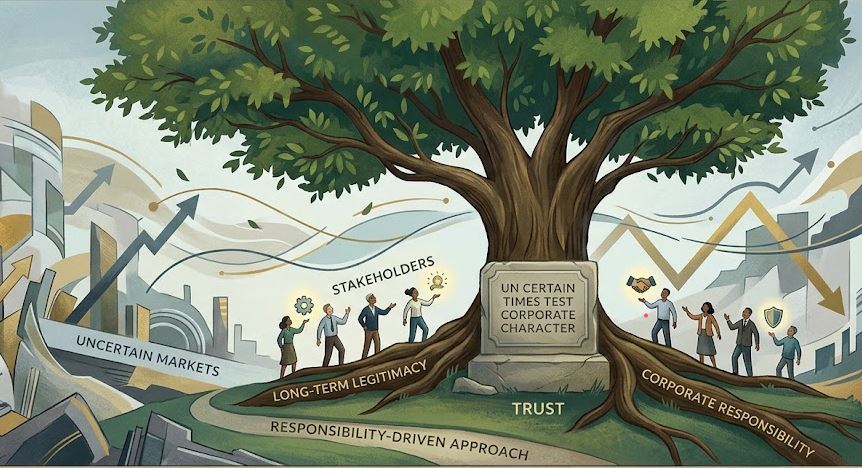
In periods of heightened uncertainty, when markets become more sensitive and expectations more demanding, corporate behaviour comes under closer scrutiny. Moments of instability do not only test economic systems. They test corporate character.
When market conditions become volatile and consumer confidence fluctuates, businesses face a defining choice. They can focus narrowly on short term profitability, or adopt a broader, responsibility-driven approach that reinforces long-term legitimacy.
Corporate responsibility is often discussed in stable environments, framed within sustainability reports and annual disclosures. However, its true significance emerges during moments of stress. It is in uncertain times that stakeholders observe more closely how companies behave, communicate and make strategic decisions.
Beyond individual sectors, the question extends to how organisations as a whole respond to pressure. Profitability remains essential. No organisation can operate sustainably without financial discipline. Yet an exclusive focus on immediate margins may weaken trust when stakeholders are seeking reassurance and stability. Employees look for continuity, customers expect fairness and suppliers value reliability. Corporate behaviour during such periods sends powerful signals about leadership priorities.
Responsible corporations recognise that uncertainty amplifies sensitivity. Pricing decisions, workforce policies, communication tone and supply chain management all carry increased reputational weight. Transparency becomes critical. Clear explanations of operational constraints, cost structures and strategic adjustments demonstrate respect for stakeholders. Ambiguity or silence, by contrast, can generate speculation and erode confidence.
Beyond communication, operational choices define credibility. Companies that prioritise continuity of service, maintain ethical practices and protect stakeholder relationships contribute to broader economic resilience. These actions are not merely symbolic. They represent strategic investments in reputational capital.
Long term competitiveness increasingly depends on trust. In volatile environments, trust functions as an intangible infrastructure that stabilises relationships. Organisations that demonstrate consistency and responsibility during difficult periods tend to emerge stronger once conditions normalise. Customers reward reliability, employees reciprocate commitment and partners value stability.
Corporate responsibility is also a matter of leadership discipline. Decision-makers operating under pressure may be tempted to pursue short-term corrective actions that prioritise immediate financial relief. While such decisions may appear efficient, they can generate lasting reputational damage. Responsible leadership requires balance, aligning short term performance with long term institutional integrity.
In small and interconnected economies, corporate conduct carries amplified consequences. Business communities are closely linked, reputational signals circulate rapidly and stakeholder memory is persistent. Responsible behaviour therefore produces multiplier effects across the wider commercial ecosystem.
Uncertain times do not reduce the importance of corporate responsibility. They intensify it. They reveal whether responsibility is embedded in strategy or confined to rhetoric.
Ultimately, the strength of an organisation is not measured solely by quarterly performance. It is measured by its ability to maintain fairness, transparency and stakeholder commitment when pressures are greatest. Profitability ensures survival. Responsibility defines how organisations are remembered. Sustainable success requires both.
Dr Karim Ben Yahia
&uuid=(email))