

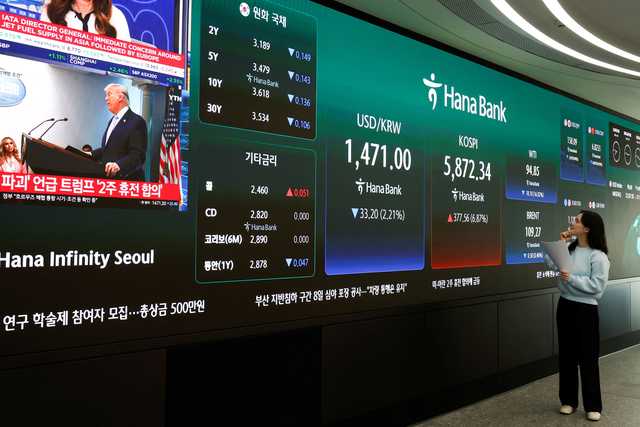
MSCI’s global equities gauge reversed course to turn higher yesterday and oil’s rally eased after Israel indicated willingness for peace talks with Lebanon, renewing hopes for the fragile Gulf truce.
The US dollar added to losses and US Treasury yields turned lower after Israeli Prime Minister Benjamin Netanyahu said he has given an instruction for Israel to begin peace talks with Lebanon that would also include the disarming of Hizbollah, which is linked to Iran.
Wall Street stocks turned from red to green after the statement seemed to ease worries that Israel’s actions in Lebanon would torpedo US President Donald Trump’s truce with Iran.
After earlier rising above $102, US crude was up 3.43 per cent at $97.71 a barrel in early afternoon trading and Brent, after rising earlier to $99.50 was trading at $95.50 per barrel, up 0.8pc on the day.
While Michael O’Rourke, chief market strategist at JonesTrading in Stamford, Connecticut said that weekend peace talks could bring some insight and promise, he noted that it could “take a little while before investors have confidence in the outlook for the war and where oil prices are going.”
“You’ve had a major equity rally where the index is only down a little more than a percent on the year. There’s nothing attractive about chasing this tape at these prices,” he said.
On Wall Street at noon, the Dow Jones Industrial Average was up 281.82 points, or 0.59pc, to 48,191.74, the S&P 500 rose 42.46 points, or 0.63pc, to 6,825.27 and the Nasdaq Composite was 172.96 points, or 0.76pc, higher at 22,807.95.
MSCI’s gauge of stocks across the globe rose 2.77 points, or 0.27pc, to 1,033.82.
The pan-European STOXX 600 index closed down 0.15pc.
Overnight in Asia, Japan’s Nikkei fell 0.7pc after jumping more than 5pc on Wednesday.
outh Korea dipped 1.6pc, following a leap of 6.8pc in the prior session and MSCI’s broadest index of Asia-Pacific shares outside Japan eased 0.7pc after Wednesday’s roughly 5pc rally.
In US Treasuries, the yield on benchmark US 10-year notes fell 2.2 basis points to 4.269pc, from 4.291pc late on Wednesday while the 30-year bond yield fell 1 basis point to 4.8755pc.
The two-year note yield, which typically moves in step with interest rate expectations for the Federal Reserve, fell 4.4 basis points to 3.75pc, from 3.794pc.
In currencies, the dollar index, which measures the greenback against a basket of currencies including the yen and the euro, fell 0.37pc to 98.69, with the euro up 0.43pc at $1.1712.
Against the Japanese yen, the dollar strengthened 0.09pc to 158.72.
In precious metals markets, spot gold rose 1.63pc to $4,793.07 an ounce while spot silver was up 2.66pc at $76.09 an ounce.
With oil prices still sharply higher than pre-war levels, inflation has been a major concern for investors, with March US Consumer Price Index (CPI) data due to be released today before the market open.
Yesterday’s data showed the PCE index of US core prices for February up 2.8pc on an annual basis and 3pc excluding the volatile food and energy components.
Both figures were in line with economists’ forecasts although a separate report showed fourth-quarter US economic growth of 0.5pc versus estimates for 0.7pc.
Bahrain All Share Index closed at 1,893.79 points yesterday, marking an increase of 5.53 points above the previous closing.
This increase was due to the rise in the financials sector, industrials sector, materials sector and real estate sector.
Bahrain lslamic Index has closed at 925.90 points, marking a decrease of 0.36 points below the previous closing.
Results indicated that 121 equity transactions took place with a volume of 1,114,706 worth BD328,129.
Investors traded mainly in the financials sector, representing 53.55pc of the total value of securities traded.
&uuid=(email))