

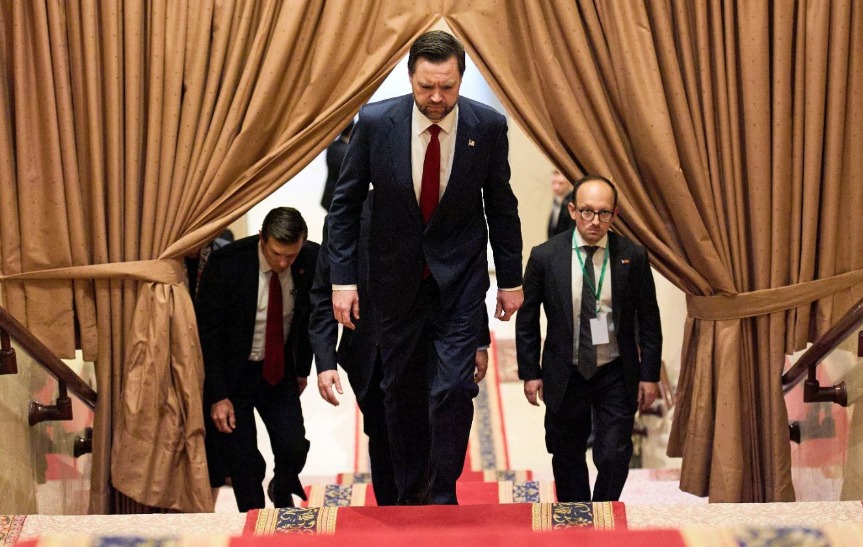
US Vice President JD Vance said on Sunday there was no deal with Iran after 21 hours of negotiations in Pakistan, citing shortcomings in the talks and saying Iran had chosen not to accept US terms.
The talks in Islamabad were the first direct US-Iranian meeting in more than a decade and the highest-level discussions since the 1979 Islamic Revolution.
The outcome could determine the fate of the fragile two-week ceasefire and the reopening of the Strait of Hormuz, a chokepoint for about 20% of global energy supplies that Iran has blocked since the war began. The conflict has sent global oil prices soaring and killed thousands of people.
Vance, special envoy Steve Witkoff and President Donald Trump's son-in-law Jared Kushner met Iranian Parliamentary Speaker Mohammad Baqer Qalibaf and Foreign Minister Abbas Araqchi for two hours before a rest, according to a source from mediator Pakistan.
"There were mood swings from the two sides and the temperature went up and down during the meeting," another Pakistani source said in reference to the first round of talks.
For the US-Iran talks, Islamabad, a city of more than 2 million people, was locked down with thousands of paramilitary personnel and army troops on the streets.
STRAIT OF HORMUZ
As the talks started, the US military said it was "setting the conditions" to start clearing the Strait of Hormuz.
The Strait of Hormuz is central to the ceasefire talks. The US military said two of its warships had passed through the strait and conditions were being set to clear mines, while Iran's state media denied any US ships had transited the waterway.
Trump's stated goals have shifted, but as a minimum he wants free passage for global shipping through the strait and the crippling of Iran's nuclear enrichment programme to ensure it cannot produce an atomic bomb.
&uuid=(email))