

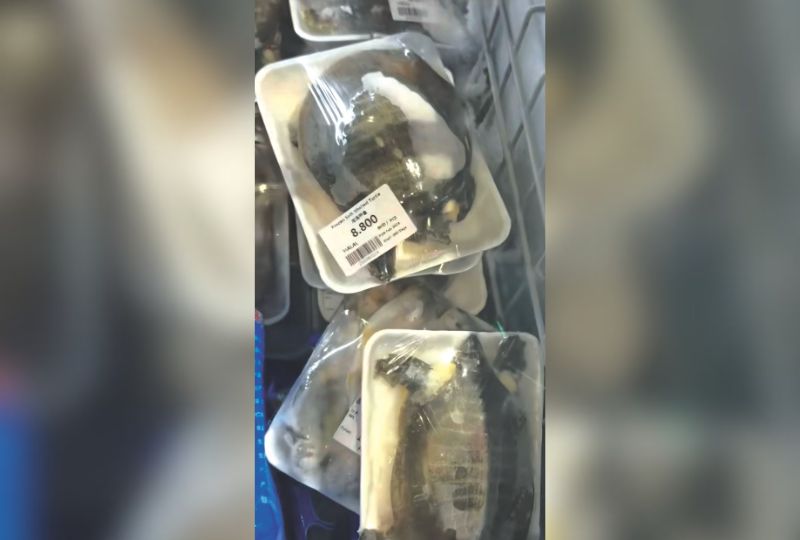
A parliamentary investigation has been launched into the alleged sale of internationally protected turtles for consumption in Bahrain’s markets.
The probe is being spearheaded by Parliament’s foreign affairs, defence and national security committee, chaired by MP Hassan Bukhammas, after reports on social media that small turtles ‘the size of an adult palm’ were being openly sold as food.
Mr Bukhammas said he had already alerted the relevant authorities to crack down on outlets involved in the alleged trade, describing the issue as both an environmental crime and a potential public health concern.
“These turtles are being sold in markets, openly, and this is extremely worrying,” he told the GDN.
“All marine turtle species are internationally protected and their trade is prohibited. How are they reaching our markets?”
He confirmed that formal inquiries had been sent to the Oil and Environment, Health, Industry and Commerce and Interior ministries demanding urgent inspection and enforcement action.
The investigation will focus on a key question: whether the turtles are being locally caught in Bahraini waters or illegally imported.
“If they are being caught locally, then marine inspectors under the Supreme Council for Environment and the Bahrain Coastguard should have intervened immediately,” Mr Bukhammas said.
“If they are being imported, then Customs Police, environmental inspectors, health inspectors and commerce inspectors each have a responsibility that must be examined.”
He warned that the issue could be a sign of a ‘more dangerous underground trade’ in banned marine life.
“Today it is turtles. Tomorrow it could be baby crocodiles, alligators, or other prohibited marine species being sold as food. If this is not stopped now, we are opening the door to a much larger problem.”
Mr Bukhammas stressed that the investigation would be thorough and transparent.
“We will follow this until we have clear answers,” he said.
“If there is negligence, it will be exposed. If there is organised trade, it will be stopped.”
The committee’s vice-chairman MP Abdulla Al Romaihi described the sale as ‘a serious breach of international environmental commitments’ and said the investigation would seek accountability.
“Bahrain is a signatory to the Convention on International Trade in Endangered Species of Wild Fauna and Flora (CITES). Under CITES, international trade in all marine turtle species is prohibited,” he said. “If these turtles are being traded here, then either our laws are being ignored or enforcement is failing. Both are unacceptable.”
He added that the committee would examine inspection procedures at markets, ports and coastal areas, and whether sufficient co-ordination exists between enforcement bodies.
The global context of the issue adds weight to the concern. Despite CITES protections among more than 160 countries, illegal trade in marine turtles remains significant worldwide.
Investigations by TRAFFIC, a wildlife trade monitoring network operated jointly by World Wide Fund (WWF) and International Union for Conservation of Nature, have shown persistent black markets for turtle meat, eggs, leather and taxidermy curios, particularly in parts of Asia.
Mr Al Romaihi said Bahrain must not become part of that chain.
“This is not only about wildlife protection. There are also health implications from consuming protected marine species caught or stored in unknown conditions,” he said.
“We need immediate enforcement, but we also need to understand how this reached our markets in the first place.”
mohammed@gdnmedia.bh
&uuid=(email))