

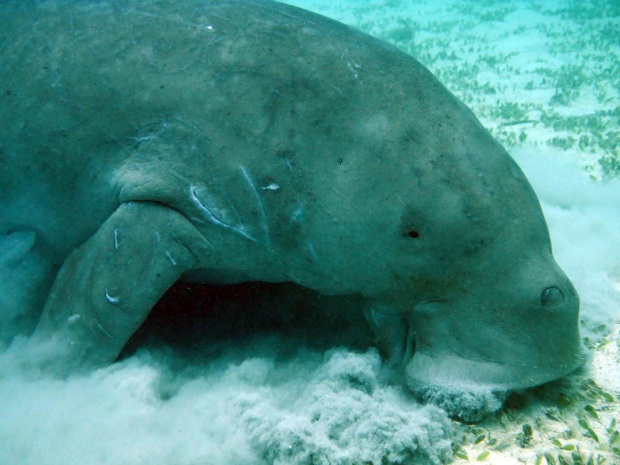
Conserving Bahrain’s ‘sea cows’ and their habitats could be key to the kingdom’s carbon capture and sustainability aspirations, according to a recently published study. Bahrain’s territorial waters host the world’s second-largest dugong or sea cow population, and their seagrass ecosystems are vital to the sustainability of sea life, carbon capture and storage, as well as biodiversity and food systems.
This is amongst the key findings of ‘Integrating megafauna into blue carbon strategies: dugongs could enhance seagrass carbon storage’ by Oswald J Schmitz and Reem Al Mealla, published recently in the peer-reviewed Frontiers in Marine Science academic journal.
“Coastal seagrass ecosystems occupy a small fraction of the global ocean yet make disproportionately large contributions to carbon capture and storage,” the authors said, in the abstract of the study. “In addition, they are increasingly promoted as blue carbon solutions within nationally-determined contributions.”
Around 1,164 dugongs – large, marine mammals related to the manatee – live in the waters near Bahrain. However, increased human activity within Bahrain seagrass beds and adjacent coastal shoreline development is introducing a new risk of habitat alteration that could force dugongs to move.
The largest herds of dugongs are concentrated northwest of Hawar Island.
The Halodule seagrass beds of Bahrain, one of the most important dugong hotspots in the world, were studied using a general animal-driven carbon-nutrient cycling model, as part of the study.
It estimated that a herd of around 700 dugongs could improve seagrass net primary production and net ecosystem carbon balance by up to 240 per cent compared to dugong-absent conditions, and sediment carbon stocks by up to 263pc.
The mechanism is nutrient recycling, not just grazing.
While dugongs reduce seagrass biomass through grazing and disturb sediments, which can release carbon, their rapid recycling of nutrients through urine, feces and carcasses compensates – fertilising new seagrass growth and enhancing ecosystem productivity.
According to the researchers, most current carbon budget models ignore this.
Across Bahrain’s 145sqkm of conservation area, dugong presence could mean an additional 79,700 metric tonnes of carbon captured per year and 638,000 metric tonnes stored in sediments – a benefit which could be lost if the herds move.
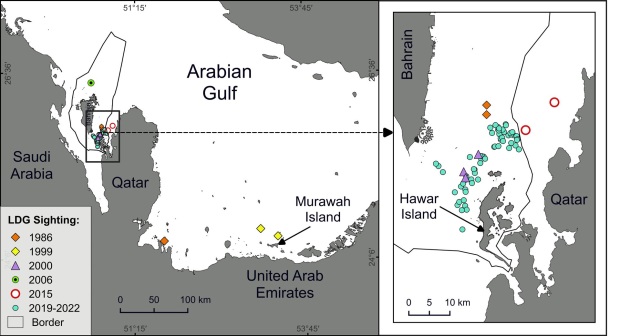
Historical and recent large dugong group (>50 dugongs) sightings in the Arabian Gulf, recorded by aerial and boat surveys as well as citizen science networks in 1986, 1999, 2000, 2006 and 2019-2022
The authors argue that animal functional roles like that played by the dugong must be explicitly included in nationally-determined contributions under climate agreements.
The GDN has previously reported that aquatic researchers have been calling for a regional network of marine protected areas to safeguard moving dugong herds.
In addition to Hawar Island, Fasht Buthur and Fasht Jarim, the 2023 study called for a regional conservation programme to be established around confirmed and potential dugong gathering sites, including Murawah Island and Al Yasat Island in the UAE, the north-western waters of Qatar, as well as the shallow waters between Saudi Arabia, Qatar and the UAE.
The aim would be to keep the areas free of fishing nets which trap dugongs and leave them to starve to death and speeding boats which knock them unconscious, seriously maim or kill them.
naman@gdnmedia.bh
&uuid=(email))