

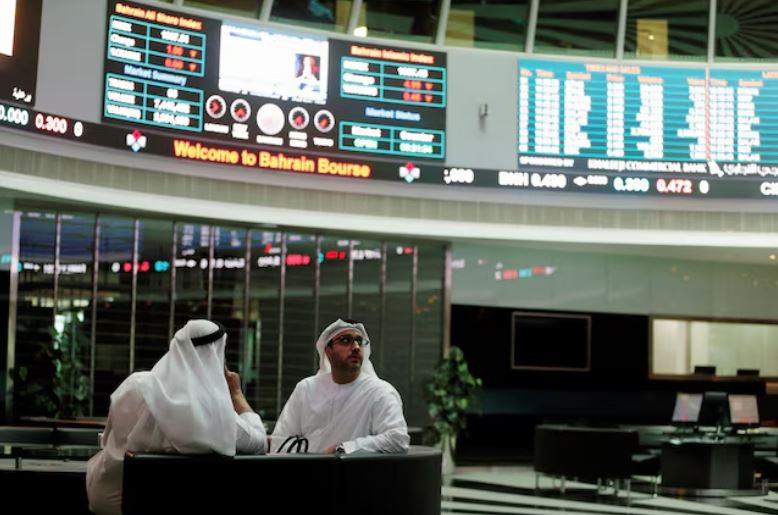
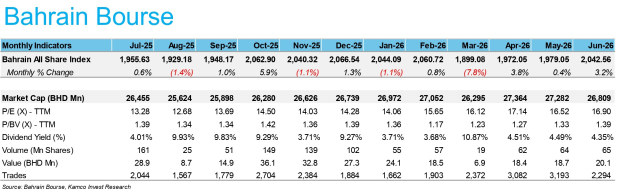
The Bahrain Bourse All Share Index surged by 3.2 per cent in June 2026, marking its third consecutive monthly advance to close at 2,042.56 points.
According to a report by Kuwait-based Kamco Invest, the strong monthly performance contributed to a 7.6pc gain for the second quarter, almost entirely erasing Q1 losses to leave the year-to-date (YTD) decline at a marginal 1.2pc.
Market sentiment was predominantly positive, with five out of seven sectors recording gains.
Market heavyweights led the rally, driven by a stellar performance in the materials sector, which jumped 10.1pc to finish at 4,502.3 points.
The financial sector climbed 2.1pc, while the industrials sector rose 1.9pc.
Conversely, the real estate sector recorded the steepest decline, dropping 3.3pc to close the month at 2,548 points.
According to Bloomberg data, United Gulf Holding was the month’s top performer, with its share price soaring 15.2pc.
Alba followed with a 10.1pc gain after finalising a major $2.2 billion acquisition of France-based Aluminium Dunkerque, the EU’s largest smelter, from AIP.
The strategic buyout aims to expand Alba’s global footprint and establish a premier low-carbon aluminium production platform.
National Bank of Bahrain also posted a strong showing, with shares rising 7.7pc.
On the decliners’ side, Ithmaar Holding led the losses with a 6.1pc drop, followed by Bahrain Islamic Bank (down 5.3pc) and Esterad (down 4.8pc).
Trading volumes saw a moderate 1pc uptick, rising to 64.5 million shares compared to 63.8m in May.
Total value traded on the exchange witnessed a substantial 7.5pc increase, reaching BD20.1m.
In terms of trading activity, GFH Financial Group topped the volume charts with 30.5m shares traded, followed by Al Salam Bank-Bahrain with 10.3m shares and Alba with 5.6m shares.
GFH Financial Group also led in liquidity, registering BD16.7m in value traded, ahead of Alba at BD5.2m and Kuwait Finance House-Bahrain at BD2.5m.

Meanwhile, Bahrain’s broader economy faces a projected 3pc contraction in 2026, weighed down by regional conflicts impacting energy markets and trade flows, according to a median estimate from a Bloomberg News survey of seven economists.
However, a sharp rebound is anticipated for next year, with the kingdom’s 2027 GDP growth forecast upgraded to 4.5pc year-on-year, up from a prior estimate of 2.8pc.
To mitigate the impact of regional instability, the Bahrain government has rolled out major fiscal reforms, including liquidity boosts and loan relief measures to support the economy.
Looking at the GCC region as a whole, negative global sentiments affected GCC markets’ performance last month with the MSCI GCC index sliding by 1.6pc nearly wiping-off all the gains since the start of the year.
In addition, an acute regional geopolitical uncertainty tied to the US-Iran conflict and the Strait of Hormuz disruption added to the overall downward pressure on regional stocks.
The decline was mainly seen in large-cap sectors including real estate, materials, banks and energy while defensive names in utilities and telecom sectors partially offset the overall decline.
A fall in crude oil prices by more than 20pc during the month affected energy names in the region.
At the country level, Oman’s MSX 30 index witnessed the biggest decline and was down for the second consecutive month with a slide of 3.2pc followed by Qatar and Saudi benchmarks with slightly smaller declines of 3pc and 2.5pc, respectively.
Zooming out further, global equity markets fell in June as escalating geopolitical tensions combined with mounting inflation worries and hawkish signals from major central banks to sour investor sentiment.
The escalating conflict between Ukraine and Russia, alongside a volatile security situation in the Middle East, fuelled market uncertainty throughout the month.
Adding to the pressure, global central banks increasingly pivoted toward policy tightening, highlighted by the European Central Bank’s first interest rate hike since 2023.
A sharp sell-off in artificial intelligence and technology stocks further weighed on broader sentiment.
Despite a late month-end rally, the benchmark S&P 500 fell 1.1pc in June, while the tech-heavy Nasdaq 100 dropped 2.8pc.
The downturn extended to Asian markets, where a slump in memory-chip shares dragged the MSCI Asia Pacific Index down 1.3pc for the month.
avinash@gdnmedia.bh
&uuid=(email))