

Bahrain’s world-class gemological laboratory and research centre has tested more than 32 million pearls and gemstones since its establishment in 2017, according to a new report.
The Bahrain Institute for Pearls and Gemstone (Danat) yesterday released its 2025 Sustainability Report, together with its 2025 Greenhouse gas (GHG) Report and the Hayrat Project Initiative, marking a new step in the institute’s efforts to advance environmental responsibility and support the conservation of Bahrain’s natural pearl oyster beds.
This initiative reflects the institute’s commitment to embedding sustainability across its laboratory services, research, education, outreach, governance and operations.
The latest report outlines its progress across environmental, social and governance areas, with a focus on climate management, marine biodiversity, pearl oyster research, blue carbon studies, resource efficiency, education, outreach and responsible operations.
“The report notes that Danat has tested more than 32m pearls and gemstones since its establishment, reflecting the trust placed in the institute and its growing role as a specialised scientific authority serving the sector locally and internationally,” said a statement yesterday.
As part of its climate-related disclosure efforts, the institute also released its 2025 GHG Report, which documents its annual greenhouse gas emissions performance and supports a more structured approach to managing its carbon footprint.
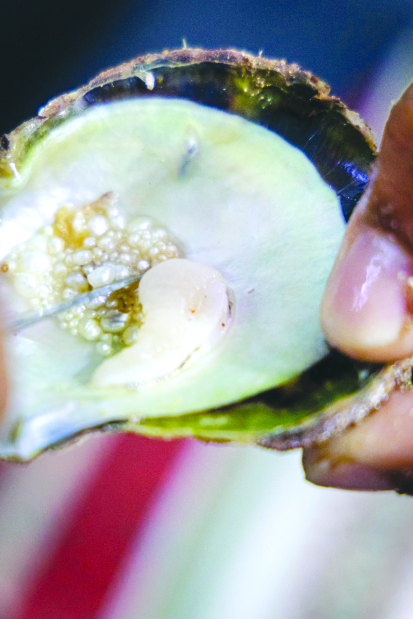
Pearls inside an oyster
According to the report, Danat’s total GHG emissions last year amounted to 313.43 tonnes of carbon dioxide equivalent (tCO2e), representing a 21.7 per cent reduction compared with the 2022 baseline.
Emissions included 2.09 tCO2e under Scope 1 direct emissions, 244.15 tCO2e under Scope 2 purchased energy emissions, and 67.19 tCO2e under Scope 3 other indirect emissions across relevant activities.
Scope 2 remains the largest contributor to Danat’s emissions profile, highlighting the importance of electricity and operational energy management as priorities for the next phase.
The Hayrat Project Initiative focuses on assessing the current status of Bahrain’s natural pearl oyster beds, comparing findings with previous surveys, and supporting evidence-based recommendations for long-term conservation.
“The findings show that most surveyed sites maintained comparable abundance and density classifications relative to previous assessments, with no evidence of widespread collapse or large-scale depletion,” it added.
“The study also observed a shift towards smaller oyster size classes, indicating continued natural recruitment, while water and sediment quality remained broadly stable.
“These results provide updated scientific evidence to support ongoing conservation and resource management efforts, while reinforcing the value of Bahrain’s natural pearl heritage as a living cultural, environmental, and renewable economic resource.”
Danat plays a vital role in upholding public trust in the jewellery and gemological community and is a wholly owned subsidiary of the Bahrain Mumtalakat Holding Company (Mumtalakat), the kingdom’s sovereign wealth fund.
“These publications reflect Danat’s commitment to embedding sustainability within its institutional vision and scientific role, enabling the institute to develop initiatives that are more closely aligned with Bahrain’s priorities in natural resource protection and environmental responsibility,” added Danat’s chief executive officer Noora Jamsheer.
“We believe that protecting this heritage is not achieved only by preserving the past, but by understanding it scientifically, managing it responsibly, and passing it on to future generations in a way that preserves its environmental, cultural, and economic value,” said Ms Jamsheer.
&uuid=(email))