

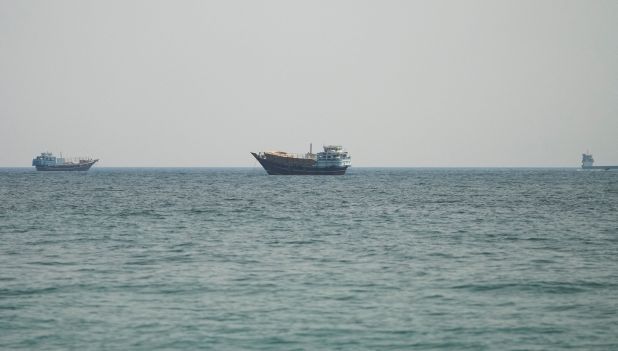
US and Iranian forces continued to exchange heavy missile and drone assaults, with the American military launching more strikes yesterday.
The military began launching more strikes against Iran at 5pm ET, US Central Command said in a statement on the social media platform X, ‘to continue degrading their ability to attack civilian mariners and commercial ships freely transiting the Strait of Hormuz’.
In a brief phone interview with Reuters in the afternoon, Trump referred to the recent strikes on Iran. “We’re beating them up,” he said.
Iranian media said there had been missile attacks and explosions around the port of Bandar Abbas, home to military facilities on the strait, and nearby Qeshm Island.
The strikes were the latest in a cycle of attacks and counter-attacks as Iran seeks to assert control over shipping through the strait. However, the barrage marked an escalation in pace and range.
US Central Command, however, said its forces were positioned to safeguard freedom of navigation despite what it described as ‘aggression, harassment, threats, and arbitrary declarations’ from Iran.
“Iran does not control the strait. Traffic is flowing,” it said.
The US Navy-led Joint Maritime Information Centre reiterated guidance that, despite a severe security threat, an ‘expanded’ southern route near Oman was available for two-way traffic.
Central Command said US forces hit 140 Iranian military targets on Saturday and more than 300 over three nights of strikes, with Iran targeting states across the Gulf.
Qatar, which has previously said it would not act as a mediator so long as it was under attack, said three people, including a child, had been injured by falling shrapnel. It said Iran was ‘fully legally responsible’ for the attack.
The UAE said it detected missile threats outside its borders, Bahrain said it intercepted several Iranian aerial attacks, Jordan reported missile strikes and Oman reported being targeted with drones.
Oman said it had summoned Iran’s ambassador to protest over the attacks in two regions.
A military source in the General Command of the Jordanian armed forces reported that three missiles fired from Iran landed in several locations within the kingdom’s territory early yesterday morning, causing no casualties but only minor material damage.
The latest round of hostilities came after talks in Oman on Saturday between Iran’s Foreign Minister Abbas Araqchi and Omani Foreign Minister Badr Albusaidi. Iran said the talks were aimed at co-ordinating arrangements in the Strait of Hormuz, and were set to continue with a Qatari presence.
Araqchi later discussed regional developments in a phone call with Pakistani Foreign Minister Ishaq Dar, whose country has been a key mediator between the US and Iran, Iran’s semi-official Tasnim news agency reported.
Pakistan’s Foreign Ministry is urging all parties to show restraint, de-escalate, and honour their commitments under the Memorandum of Understanding, pledging full support for lasting regional peace through dialogue and diplomacy.
The renewed violence casts further doubt on the future of an interim US-Iranian agreement signed last month that aimed to reopen the strait and end the war after a further 60 days of negotiations.
In the past week, US President Donald Trump has said he considers the ceasefire over, while leaving the door open to more talks.
The war that began with US and Israeli strikes against Iran on February 28 has destabilised the Gulf, while Iran’s effective blockade of the strait has driven energy prices higher, fuelling global inflation.
Iran has sought to establish a permanent system for collecting fees in the strait, which carried one-fifth of the world’s oil and liquefied natural gas shipments before the war, and has warned vessels not to sail without its authorisation.
It said late on Saturday it had closed the waterway after firing a warning shot that struck a vessel travelling on an unauthorised route. Yesterday, it said it had disabled a second vessel.
On Tuesday, the US revoked the licence authorising the sale of Iranian crude after Qatari and Saudi commercial tankers came under fire.
While Iran has not claimed responsibility for earlier ship attacks, analysts say Tehran uses such actions to gain leverage in negotiations.
Again, the Gulf states and others have widely condemned the Iranian aggression.
GCC Secretary General Jasem Mohamed Al Budaiwi denounced in the strongest terms Iran’s continued destabilising behaviour regarding regional security and stability, its repeated brutal targeting of Bahrain, the UAE, Oman, Qatar, Kuwait and Jordan, as well as its dangerous attacks on commercial vessels.
The secretary general said that Iran’s behaviour constitutes a grave violation of the principles of international law, the United Nations (UN) Charter, and UN Security Council Resolution 2817, as well as a direct undermining of maritime security and freedom of navigation.
He emphasised that these repeated, brutal Iranian attacks not only hinder all endeavours aimed at achieving security and stability in the region, but also reveal a systematic insistence on perpetuating chaos, in blatant defiance of international law and the international community’s shared will to establish peace.
Arab League Secretary General Nabil Fahmy likewise stressed that there can be no justification for such unacceptable and repeated attacks. He affirmed that the security of Arab states is indivisible and that any violation of the sovereignty of an Arab country is completely unacceptable and requires a united and resolute Arab response.
Saudi Arabia condemned the latest round of Iranian attacks on neighboring countries and ships in the Strait of Hormuz, describing Iran’s conduct as destabilising.
A spokesman for UN Secretary-General said António Guterres is deeply concerned by the serious escalation and renewed military confrontations in the Gulf, including the Iranian attacks on ships in the Strait of Hormuz, the attacks by the United States on Iran, and the attacks by Iran on targets in the neighbouring countries.
“These attacks must all stop. He calls on all parties to exercise maximum restraint.”
&uuid=(email))