

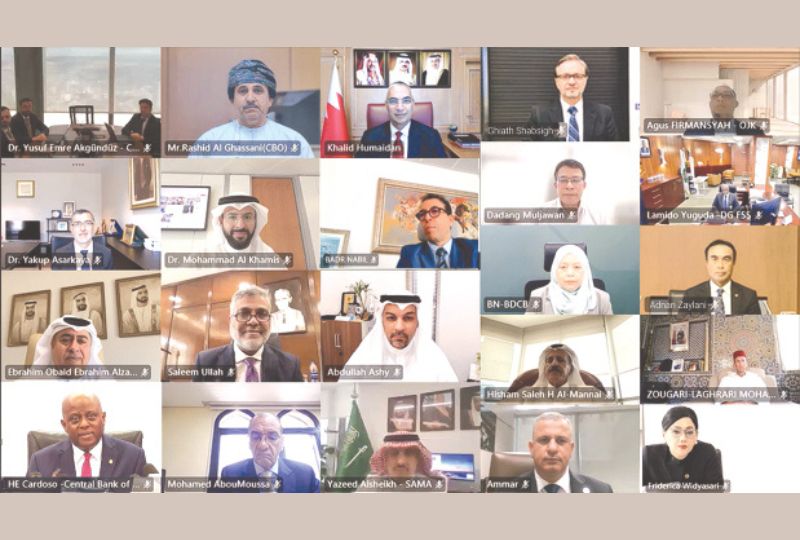
The Central Bank of Bahrain (CBB) hosted the Islamic Financial Services Board (IFSB) annual meetings 2026 virtually on Monday.
The meetings were organised by the IFSB and chaired by CBB Governor and current chairman of the IFSB Council Khalid Humaidan.
The meetings were attended by central bank governors, deputy governors, and senior representatives of regulatory and supervisory authorities.
The agenda included the 48th IFSB Council meeting and the 24th general assembly, convening nearly 100 high-level participants, including senior representatives from central banks, supervisory authorities, financial institutions, multilateral organisations and industry stakeholders from across the Islamic financial services industry.
In addition to discussing the ISFB’s strategic priorities, participants examined ways to strengthen co-operation and advance sound regulatory practices across Islamic banking, takaful and capital markets.
In his opening remarks, the Governor noted how Islamic finance became an integral part of financial systems worldwide, reflecting the industry’s growing maturity, diversification, and global relevance.
According to the latest IFSB Islamic Financial Stability Report, global Islamic financial assets reached approximately $4.4 trillion in 2025.
He also highlighted Bahrain’s pioneering role over the decades in the development of Islamic finance.
He noted Bahrain’s commitment to supporting the IFSB’s mandate and contributing to the development of Islamic finance through a regulatory environment that encourages innovation while safeguarding stability and sustainable growth.
The IFSB is an international standard-setting body for Islamic finance that works closely with international organisations, regulatory and supervisory authorities, and regional partners, aligning its efforts with global standards towards the sustainable growth and development of Islamic finance, and serves as a platform for co-operation and knowledge sharing among its members.
Through its participation, the CBB continues to support meaningful dialogue around international standardisation and capacity-building measures, enabling institutions to adapt to an evolving industry landscape.
&uuid=(email))