

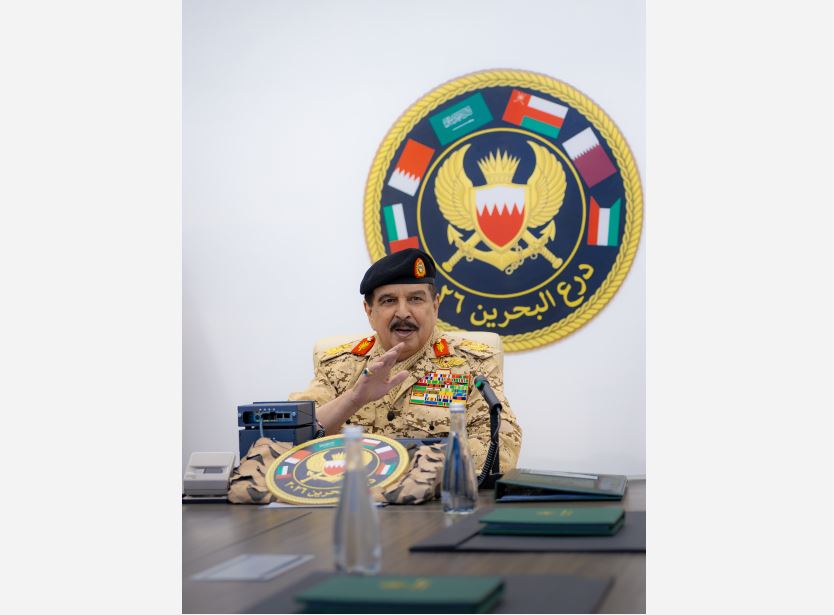
AGAINST the backdrop of Iranian aggression and the actions of its proxies across the region in recent months, the joint ‘Bahrain Shield’ exercise, involving the member states of the GCC, sent a clear message: Gulf security can no longer be built on reactive measures but on a collective deterrence system founded on political resolve, military integration and strategic partnerships. Such a framework safeguards development and stability while protecting the Gulf’s shared destiny in the face of regional threats. The exercise also reaffirmed a fundamental fact: the security of any GCC state is inseparable from the security of the Gulf as a whole.
Perhaps the exercise’s most significant message, reinforced by the address of His Majesty King Hamad, Supreme Commander of the Armed Forces, was that investing in defence integration is, at its core, an investment in peace, stability and development – not a call for escalation or confrontation. Building a joint military capability is not intended to ignite wars, but to prevent them by strengthening deterrence and raising the cost of any aggression, thereby safeguarding nations’ security and preserving their developmental and civilisational achievements.
The speech extended beyond highlighting Gulf defence integration to underscore the importance of security and defence partnerships with brotherly nations, friends and allies as a complementary pillar of the regional security architecture. The challenges confronting the region have become increasingly transnational, making coordination, the exchange of expertise and the enhancement of joint capabilities indispensable to strengthening stability and protecting vital interests. This vision reflects the reality that Gulf security is no longer solely an internal responsibility but part of a broader framework of cooperation based on shared interests, respect for international law and the protection of international maritime security – principles that enhance the region’s ability to confront emerging challenges and preserve the developmental achievements it has attained.
Among the most profound messages in the King’s speech was his observation that Iran has disregarded the bonds of Islam and forgotten the blessings that the Prophet Mohammed’s message bestowed upon the Persian nation. This was not merely a religious reference but a political and intellectual statement emphasising that the issue is not one of Arabs versus Persians. Rather, it is between an approach that upholds Islam’s enduring values of brotherhood, good neighbourliness, fidelity to commitments and respect for state sovereignty, and another approach that exploits religion to advance expansionist ambitions and fuel conflict. In doing so, His Majesty established a clear standard by which conduct should be judged: adherence to the true values of Islam, not the mere uttering of its slogans.
The King’s reference to the Prophet’s message also reflected his conviction that Islam was revealed to foster the flourishing of civilisation, not the perpetuation of conflict. Defending the homeland, therefore, is not simply about protecting geographical borders but about safeguarding a civilisational project built on peace and prosperity.
His Majesty’s reference to the profound impact of Islam on the Persian nation also carries important historical and civilisational significance. Islam was never exclusively an Arab faith; it was a universal message that inspired the advancement of many peoples, foremost among them the Persians, who after embracing Islam produced distinguished scholars, jurists and thinkers whose contributions enriched the Islamic civilisation and advanced the sciences of Qur’anic exegesis, Hadith, jurisprudence, language, medicine, astronomy and philosophy. Recalling this historical reality reinforces the principle that relations among the peoples of the region should be grounded in the Islamic values of justice, compassion, fraternity and good neighbourliness – not in policies of expansion and the fomenting of disputes.
At the same time, the King’s address conveyed a message of balance and wisdom. It did not close the door to normal relations with Iran but made clear that such relations depend on a change in behaviour; more specifically adherence to the principles of good neighbourliness, respect for the sovereignty of other states and an end to interference in their internal affairs. Only then can regional relations return to their natural foundations of mutual respect and shared interests.
The gravest threat facing nations in times of crisis is not merely the clash of interests but the erosion of values. That is why the King’s speech emphasised that the Gulf’s true strength cannot be measured by the number of soldiers or the sophistication of its military hardware. It lies in the genuine brotherhood of its peoples, the trust they place in one another and their unity of purpose and destiny.
Perhaps the most powerful phrase in the address – ‘Our blood is one on every front’ – was far more than a description of military solidarity. It was a declaration of a deeply rooted Gulf doctrine: that Gulf security is indivisible and that defending any GCC state is the responsibility of all. It is a message affirming that genuine peace can only be secured through unity, and that the solidarity of brotherly nations remains the cornerstone of regional security, stability and the protection of the Gulf’s future. If shared blood has united Gulf nations on the battlefield, it is shared values that unite their will in the task of building the future. Together, the unity of blood and values will continue to strengthen the Gulf’s security, stability and enduring civilisational mission.
&uuid=(email))