

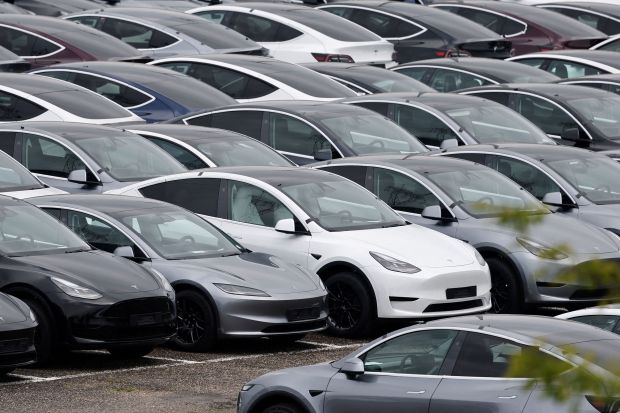
Tesla beat Wall Street estimates for third-quarter deliveries yesterday, as a demand rebound in Europe offset the loss of US tax incentives and stiffer competition in China.
Shares of the Austin, Texas-based company rose more than 3 per cent in early trading. Through last close, the stock had fallen more than 21pc so far this year.
The figures suggest Tesla’s core car business, its biggest revenue driver, may be leveling off after two straight years of falling annual sales, even as investors increasingly look past quarterly deliveries to CEO Elon Musk’s push into AI, robotaxis and humanoid robots.
Tesla’s roughly $1.40 trillion valuation depends heavily on those long-term ambitions, even though vehicle sales are still its largest source of revenue.
Its robotaxi service is still small compared with Alphabet’s Waymo, which runs commercial services in several US cities.
Tesla delivered 486,532 vehicles in the July-September period, compared with analysts’ average estimate of 456,896 vehicles, according to data compiled by Visible Alpha. It needs to deliver at least 311,448 vehicles in the fourth quarter to avert a third straight annual decline in deliveries.
“The strong numbers put Tesla on track for full-year deliveries growth following two years of declines. I point to FSD (Full Self-Driving) as being a differentiator that drives consumers to choose Tesla over other autos,” Morningstar analyst Seth Goldstein said.
Demand looked strong going into the quarter as finance chief Vaibhav Taneja said in July Tesla ‘exited Q2 with our largest order backlog since 2023.’
Unlike earlier this year, analysts have raised their full-year forecasts – now expecting 1.82 million deliveries in 2026, up from 1.65m in the June consensus.
&uuid=(email))