

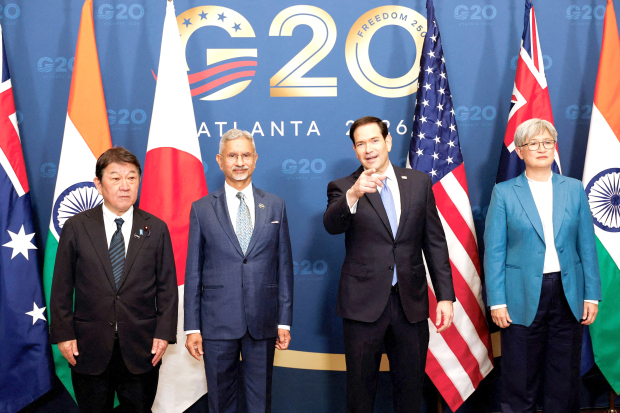
The foreign ministers of the US, Australia, India and Japan pledged yesterday to work to build reliable global supply chains, expressing ‘grave concerns’ about what they described as economic coercion through export restrictions and non-market practices.
A joint statement by the foreign ministers of the Indo-Pacific ‘Quad’ did not explicitly identify China, but came at a time when Japan has been extremely critical of Beijing over its restrictions on critical mineral exports.
The meeting came shortly before the final session of a meeting of foreign ministers from the Group of 20 major economies, which includes China.
The ministers reiterated their support for a free and open Indo-Pacific, underscoring the importance of economic security in maintaining global stability and prosperity, including through reliable and open global supply chains.
“They expressed grave concerns regarding economic coercion, including through arbitrary export restrictions, as well as non-market policies and practices that result in overcapacity to disrupt global supply chains in critical industries,” the joint statement said.
The ministers also emphasised the ‘absolute necessity to protect and preserve navigational rights and freedoms in the Strait of Hormuz, the Red Sea, and the Bab Al Mandeb Strait,’ the statement said.
It was the third meeting of the Quad foreign ministers this year, with plans nowtaking shape for US President Donald Trump to attend his first formal meeting of the leaders of the four countries next month in Manila during a conference of the Association of Southeast Asian Nations.
After the Quad ministers’ meeting, US Secretary of State Marco Rubio hosted a final plenary session with foreign ministers from the Group of 20 major economies during a two-day summit in Atlanta, where the participation of Russian Foreign Minister Sergei Lavrov highlighted deep rifts among G20 members.
Canadian Foreign Minister Anita Anand told Reuters in an interview that she would not have chosen to invite Lavrov, but she used the occasion to confront him directly about Russia’s full-scale invasion of Ukraine in February 2022.
“I stared him in the eye and called out Russia’s further illegal invasion of Ukraine, the stealing of Ukrainian children, the targeting of Ukrainian ships in the Black Sea, all of which are reprehensible, all of which are contrary to international law and international humanitarian law,” Anand said, citing her remarks during a closed-door plenary session on Friday.
