

Manama: Activists have expressed concern over a spate of attacks on schools shortly before the new academic term is set to start.
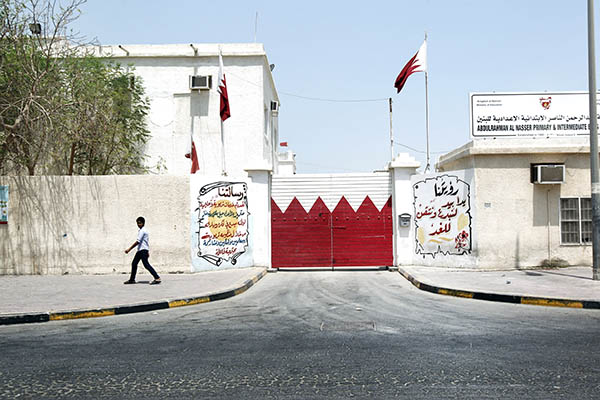
It follows three incidents outside government schools in Muharraq in the space of a week, including the discovery of two suspicious objects placed near the Abdulrahman Al Nasser Primary and Intermediate School on Monday night.
The Interior Ministry said that while police were dealing with the situation one of the devices exploded, although no injuries were reported.
Prominent human rights activist Salman Naser has compiled a report on attacks against schools and security forces based on figures supplied by the Interior Ministry.
He found that although assaults on the police had dropped in recent years – rioters have seemingly found a new target.
“If we look at the figures the number of illegal political protests dropped from 1,818 in 2013 to 1,504 last year,” he told the GDN.
“Injuries among policemen because of Molotov attacks and homemade explosives dropped from 945 cases in 2013 to 322 last year.
“Even the attacks on police stations by thugs dropped from 179 cases in 2012 to 63 cases in 2014.
“Instead, these people are planting bombs or hurling Molotov cocktails at schools and destroying public property to create panic among young students and parents.”
Last week, an improvised explosive device went off near Tariq Bin Ziyad Intermediary Boys School in Muharraq.
Mr Naser said since 2011 there had been hundreds of attacks on schools, which according to the Education Ministry has cost the government more than BD2.6 million.
The types of attacks have varied from trespass to theft, arson, planting of explosives and forced road closures.
“The recent blast near a school in Muharraq is not the first time educational institutions have been targeted in Bahrain,” said Mr Naser.
“Based on a study of official figures released by the Education Ministry around 40 per cent of government schools in Bahrain were targeted last year and even the Arab League Educational, Cultural and Scientific Organisation has condemned these politically motivated attacks.
“These radical elements in our society that want to terrorise children and parents should be stopped.
“We need to step up security outside all schools in Bahrain as thousands of students start the new academic year next month.”
The activist further cited the example of the Sitra blast last month in which two policemen were killed and six others injured after high-grade explosives were placed on a street corner near Gurnata Primary School for Girls.
During a televised confession earlier this month one of the suspects said he and a co-defendant had dug a hole near the school’s wall, planted the bomb and covered it with bricks and sand.
Bahraini psychiatrist Dr Sharifa Swar described the increase in attacks on schools as an “alarming” trend carried out by “brainwashed” youths.
“They are brainwashed and exploited by radical groups,” she said.
“It is alarming to see schools continually targeted, as we are dealing with misguided young men who need psychological help.”
Meanwhile, a Bahraini who lives near the Abdulrahman Al Nasser Primary and Intermediate School in Muharraq told the GDN how terrified his family had been by Monday night’s blast.
“We finished having our dinner and then heard a loud noise outside,” said the man, who did not want to be named. “By the time we went outside there was black smoke and the police helicopter was circling overhead.”
In an unrelated incident, this same school was targeted by a group of masked vandals in March 2013, who broke through the front gate and tried to damage school property before being stopped by a security guard.
The new academic term in Bahrain will start in less than two weeks.
sandy@gdn.com.bh
&uuid=(email))