

Manama: Removing President Bashar Al Assad from power in Syria is the best way to tackle the mounting humanitarian crisis and stop the flow of refugees to Europe, according to one of America’s most experienced Middle East military commanders.
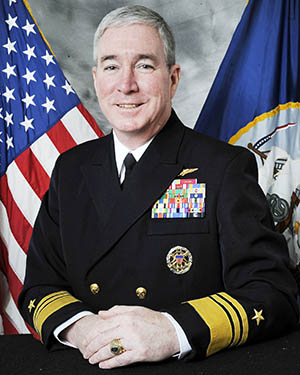
Vice Admiral John Miller, who was in charge of the US Navy’s Bahrain-based Fifth Fleet, US Naval Forces Central Command and Combined Maritime Forces for more than three years before handing over responsibility last week, described the solution to the situation in Syria as “fairly straightforward”.
Having overseen the US Navy’s involvement in operations targeting the Islamic State (Daesh), he told the GDN in an exclusive interview that toppling Al Assad should be the main priority.
“In Syria, it’s fairly straightforward in terms of what needs to happen,” he said.
“We need to defeat Daesh in Syria and then we need to get Assad out of power, he’s killed over 200,000 of his own people.
“So the real solution in Syria is to do those two things: defeat Daesh and then defeat the dictator who is murdering his own people so then you can relieve the humanitarian crisis in Syria, so that you don’t have these thousands and thousands and thousands of refugees.”
Speaking shortly before returning to the US, the former naval flight officer said it was “astonishing” that the Syrian president was still in power more than four years after the outbreak of a bloody civil war that has so far forced more than four million to flee the country, while more than seven million have been internally displaced and an estimated 12m inside Syria need humanitarian assistance.
“He’s there because he’s supported by Iran and other countries that enable him to continue to stay in power,” said Vice Admiral Miller.
“Him remaining in power destabilises Jordan, it destabilises Lebanon, it’s destabilising to an increasing extent to Turkey.
“That creates the refugee crisis that we are talking about, which is an enabling force for Daesh in the first place.
“Until you get to the root cause you are not going to solve the refugee problem and you are not going to solve the destabilisation of really the entire region.
“It is astonishing that he still is in power, but you have got to solve it in sequence.
“I think the way you do that is it’s Daesh in Iraq, then it’s Daesh in Syria and then it’s Assad in Syria.”
However, he explained that slow progress in defeating the IS in Iraq meant that “a great deal of patience” was required.
“It’s slow progress certainly and we continue to support the Iraqi security forces, but it’s only going to go as fast as the Iraqi security forces can go on the ground,” he said.
“The primary contribution we (the US) continue to make is with air power, but it’s slow.
“If you look for example at the battle for Ramadi they (Iraqi forces) are making progress, but it’s slow progress. I think ultimately they will be successful in Ramadi, but it requires a great deal of patience.”
Vice Admiral Miller, who previously served as special assistant to the US Deputy Chief of Naval Operations for Operations, Plans and Strategy, highlighted the importance of empowering all sections of Iraqi society for the fight against IS to be successful, but admitted that remained a challenge.
“By and large the biggest challenge is that the Iraqis, the Iraqi government in particular, needs to empower all of the different parts of Iraq,” he said.
“They need to empower the Sunnis, they need to empower the Kurds and they need to empower the Shia so that at the end of it you have a whole Iraq and it’s secure – and that continues to challenge them frankly.”
However, he suggested reforms spearheaded by Prime Minister Haider Al Abadi were a step in the right direction.
“It’s always important to understand when you deal with the Iraqis that you need to bring a certain amount of patience with you,” he said.
“It does seem like Prime Minister Al Abadi understands what he has to do, but understanding what you have to do and having the political capital to get it done are not necessarily the same thing.
“Some of the reform initiatives I think he’s working tend to tell us that he understands what he has to do, it’s just difficult to get it done.”
In the meantime, he said there was little appetite among the US and its coalition partners also conducting air strikes against IS to get involved in any other capacity in Iraq.
“I don’t sense that there is right now, I don’t know if that will be different as we get further along in this,” he said. “We will have to wait and see.”
rsmith@gdn.com.bh
Also read related stories :
Sanction relief ‘won’t hurt Gulf’
Lifting arms ban ‘was correct’
&uuid=(email))