

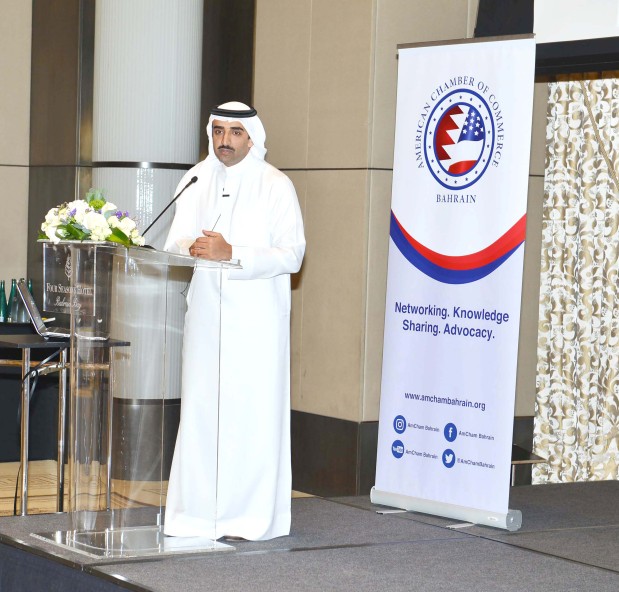
MANAMA: US contractor Halliburton will start drilling two wells this October in the Khaleej Al Bahrain oil and gas field, Oil Minister and National Oil and Gas Authority of Bahrain (Noga) chairman Shaikh Mohammed bin Khalifa Al Khalifa told American Chamber of Commerce in Bahrain (AmCham) members yesterday.
Delivering the keynote at a luncheon hosted by AmCham, the minister said the wells were part of a research and evaluation phase set to end in June next year.
Sharing details about plans to exploit the new discovery of 80 billion barrels of unconventional oil and up to 20 trillion cubic feet of tight gas in shallow-waters off its west coast, Shaikh Mohammed said international partners may be selected in December 2019 for the production phase.
Work to be done by Halliburton will include geological surveys as it appraises how much of the oil contained underground is actually recoverable. Analysts suggest that despite the significant number of barrels, an offshore shale oil field could only yield between five and ten per cent of the total estimated oil in place.
However, the minister was optimistic it may be closer to 15pc due to continuing improvement in technologies.
As for costs of drilling, he said shale wells onshore typically cost about $8-10 million to drill and frack in the US, and he expected the offshore project to cost somewhat higher.
The waters of the Gulf are shallow in that area, which will help reduce production costs, he said.
“Initial flow tests were positive with the reservoir rocks showing good porosity.”
Shaikh Mohammed also said international oil companies particularly US upstream players would be invited to help in the development of the field.
Talking about the $4.2bn Bapco Modernisation Programme, that would boost the refinery’s production capacity from 267,000 barrels per day to 360,000 bpd, the minister said the project would conservatively yield double-digit returns based on debt numbers.
The programme would also expand the refinery’s capabilities for bottom-of-the-barrel processing as well as improve overall energy efficiency and output of cleaner products that meet stricter environmental standards, he said.
Bapco also has plans to diversify into chemicals to increase its profit margins, including a planned aromatics facility in a joint venture with Kuwait’s state-owned Petrochemical Industries Company and a possible foray into olefins, added Shaikh Mohammed.
Providing updates on the region’s first liquefied natural gas (LNG) receiving and regasification terminal, intended to help Bahrain meet the increasing demand for gas supplies for industrial and urban development, he said the project was on track to meet its commercial start date in 2019.
“A key component of the project is the Floating Storage Unit (FSU) – a tanker named Bahrain Spirit – is under construction at Daewoo Shipbuilding and Marine Engineering in South Korea.
It is set to arrive in Bahrain by the end of the year,” said Shaikh Mohammed.
The estimated $990m Bahrain LNG terminal will have a capacity of 800m cubic feet per day.
avinash@gdn.com.bh
&uuid=(email))