

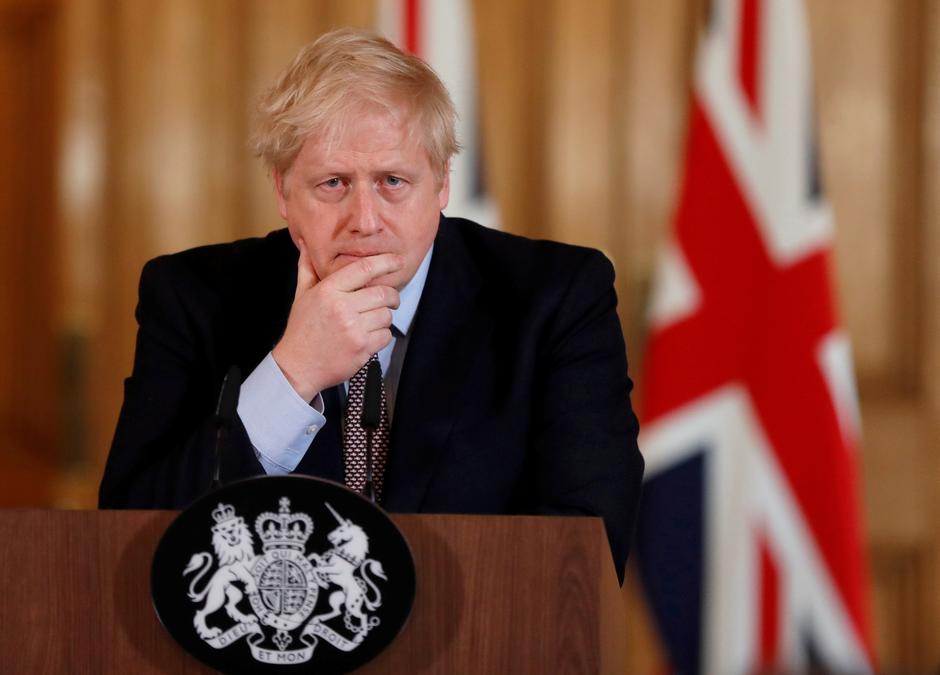
LONDON: The British government had a contingency plan for Prime Minister Boris Johnson’s death as he battled Covid-19 in intensive care last month, he said in an interview with The Sun newspaper.
Johnson, 55, returned to work on Monday, a month after testing positive for Covid-19. He spent 10 days in isolation in Downing Street before he was taken to London’s St Thomas’ Hospital where he spent three nights in intensive care.
“They had a strategy to deal with a ‘death of Stalin’-type scenario,” Johnson was quoted as saying in The Sun. “It was a tough old moment, I won’t deny it.”
Johnson said that during the period when he was self-isolating in Downing Street, he had resisted going to hospital.
“I was in denial because I was working and I kept doing these meetings by video-link,” he said.
“But I was really feeling pretty groggy ... I was feeling pretty wasted, not in an intoxicated way, but just, you know, pretty rough.”
“Then I was told I had to go into St Thomas’. I said I really didn’t want to go into hospital. It didn’t seem to me to be a good move but they were pretty adamant. Looking back, they were right to force me to go.”
Johnson was admitted to a ward on April 5 and given oxygen via a face mask and a tube in his nose. “I was going through litres and litres of oxygen for a long time,” he said. He was moved to intensive care on April 6.
At one point, doctors discussed invasive ventilation.
“The bad moment came when it was 50-50 whether they were going to have to put a tube down my windpipe,” he said. “That was when it got a bit? .?.?.? they were starting to think about how to handle it presentationally.
“The doctors had all sorts of arrangements for what to do if things went badly wrong ... The bloody indicators kept going in the wrong direction.”
The remarks were Johnson’s most candid yet on his brush with death, though he acknowledged when he left the hospital that his fight to survive “could have gone either way,” as he paid tribute to the two nurses who never left his bedside for 48 hours.
Jenny McGee from New Zealand and Luis Pitarma from Portugal, he said, embodied the caring and sacrifice of National Health Service staff on the front lines of the pandemic, which has already killed 28,446 people in Britain.
After Johnson was discharged, St Thomas’ said it was glad to have cared for the prime minister, but the hospital has given no details about the gravity of his illness beyond stating that he was treated in intensive care.
Johnson and his fiancée, Carrie Symonds, on Saturday announced they had named their newborn son Wilfred Lawrie Nicholas, partly as a tribute to two intensive care doctors called Nicholas who they said had saved Johnson’s life.
- The UK’s death toll from Covid-19 rose to 28,446, an increase of 315, according to latest data yesterday that includes hospitals and other settings like nursing homes.
- Britain will trial a new coronavirus tracing programme next week on the Isle of Wight, just off the south coast of England, cabinet minister Michael Gove said as the government looks at how to minimise the risk of a second wave of infection.
“This week we will be piloting new test, track and trace procedures on the Isle of Wight with a view to having that in place more widely later this month,” he said.
&uuid=(email))