

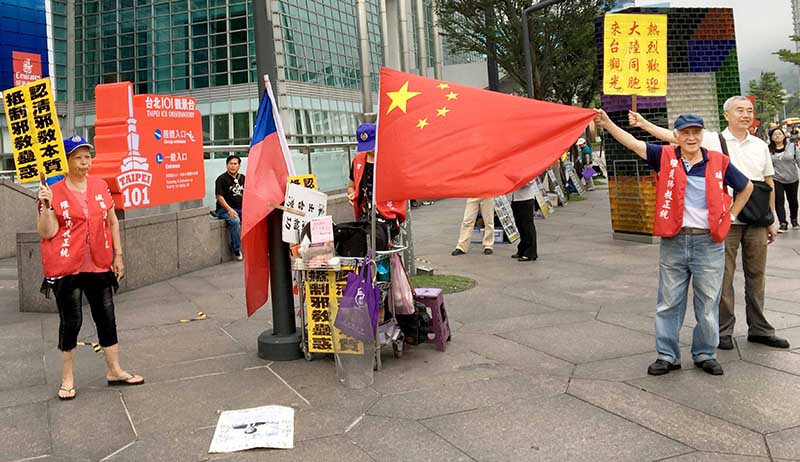
Despite the myriad obvious differences, there are more similarities between Bahrain and Taiwan than you might expect.
There is a massive Gulf between their respective languages, cultures and religions, but both are renowned for their hospitality to guests and liberal outlook.
They are each making strides to reinforce their place in the international arena, encountering economic challenges that require fiscal reform and both are facing off against more powerful adversaries who lay claim to their territory.
For Bahrain the threat looms large from Iran, which has a history of meddling in its domestic affairs and stands accused of stoking the flames of unrest by supplying weapons, training and a political dogma designed to undermine authorities in Manama.
The Taiwanese, meanwhile, continue to cast nervous glances across the Taiwan Strait to mainland China (officially the People’s Republic of China), which claims ownership of the island despite Taiwan regarding itself as a sovereign state.
In both cases the US has played a prominent role, regarded by many as a guarantor of security for its smaller allies.
Most would agree that Tehran’s repeated claims that Bahrain is a province of Iran are far more tenuous than China’s claims on Taiwan, given the rest of the world has long recognised Bahrain’s independence.
For Taiwan (officially the Republic of China), the issue is much more complicated and only 22 countries around the world (including the Vatican) officially recognise it as a nation in its own right, despite having a population of around 24 million.
However, the election of Taiwan’s first female president Tsai Ing-wen – whose Democratic Progressive Party (DPP) is traditionally anti-China and pro-independence – last month signals a new push for global recognition and the ripples could soon be felt in the Middle East.
In her inaugural speech she outlined plans to ensure Taiwan is able to “fulfil our duty as a citizen of the world and contribute towards diplomatic and global issues”.
“We will bring Taiwan closer to the world and the world closer to Taiwan,” she pledged.
While most of her focus will be on building partnerships with neighbours, such as ASEAN countries in addition to India, there could potentially be a bigger role for Taiwan in this region – particularly in terms of counter-terrorism co-operation.
“The new government will support and take part in international co-operation on emerging global issues including humanitarian aid, medical assistance, disease prevention and research, anti-terrorism co-operation and jointly tackling transnational crime,” she said.
“Taiwan will be an indispensable partner for the international community.”
While experts have played down suggestions that Taiwan could commit military forces to US-led coalitions in this part of the world, given disputes closer to home, there is a suggestion that it could engage in other ways – particularly given its advancements in technology.
“Co-operation between Taiwan and the Middle East is possible,” said Su Tzu-yun, director of the Centre of Advanced Technology at Taiwan’s Tamkang University.
“We can work on security issues including energy issues. Lots of Middle East countries are developing green energy, counter-terrorism. Taiwan is very advanced.
“The Middle East needs co-operation in ICT – we are the biggest exporter in the world.”
Meanwhile, Taiwan Thinktank executive director Lai I-chung highlighted concerns that migrant workers from predominantly Muslim Indonesia could carry the threat from Islamic State (IS), making the militant group a common enemy.
“We will certainly step up our efforts at counter-terrorism,” he said.
Taiwan has already stepped up its engagement with Bahrain, dispatching two delegations here last month shortly before the new president was sworn in.
One consisting of 30 Taiwanese manufacturers and suppliers held meetings with businessmen in Bahrain as part of a tour that also took them to Saudi Arabia, Kuwait and the UAE.
The other included 12 members promoting Taiwanese food exports, including fruit and fish.
However, you get the feeling that issues closer to home will continue to dominate Taiwan’s domestic and foreign policy.
Just two days before President Tsai’s election China’s military conducted landing exercises on its southeast coast, just across the water from Taiwan.
The timing was interpreted as a warning to the new government in Taiwan’s capital, Taipei, against making any bold moves that could unsettle the delicate balance in relations.
An inauguration address by the new president was vague, using diplomatic language that characterises sensitive “cross-trade relations” with the mainland.
She acknowledged the existence of a 1992 agreement that there is only “one China” – but said both sides “must set aside the baggage of history and engage in positive dialogue”.
However, last week she visited two military bases in the east of the island and Taiwan remains committed to being part of the Trans Pacific Partnership (TPP) with the US, while bidding for observer status at Interpol.
The new government has also adopted a “Southward Bound” policy designed to bring Taiwan’s economy closer to the economies of Southeast Asia and India, as well as reduce reliance on China for its exports.
Meanwhile, its Health Minister Lin Tsou-yen has just attended a meeting of the World Health Organisation, from which Taiwan was expelled in 1972, as an observer – an invitation extended annually since 2009.
However, while Bahrain has a host of powerful allies ready to stand by its side regardless of Iran’s attempts to interfere, Taiwan must tread more carefully.
In fact, Taiwan’s attempts to establish a foothold on the international stage will ultimately depend on China, a fact acknowledged by Taiwan Institute of Economic Research Department of International Affairs Director Chen-Sheng Ho.
“It doesn’t mean we want to be antagonists towards China,” he said.
“We hope they will understand us and give us some space otherwise the younger generation will feel like they are just being pushed around – that they are not able to do what they want to do within the framework of the peace in cross-trade relations.
“More negotiations are certainly needed, otherwise I don’t think China will just step aside.
“It’s not possible at the moment, but you need to build their confidence.”
&uuid=(email))