

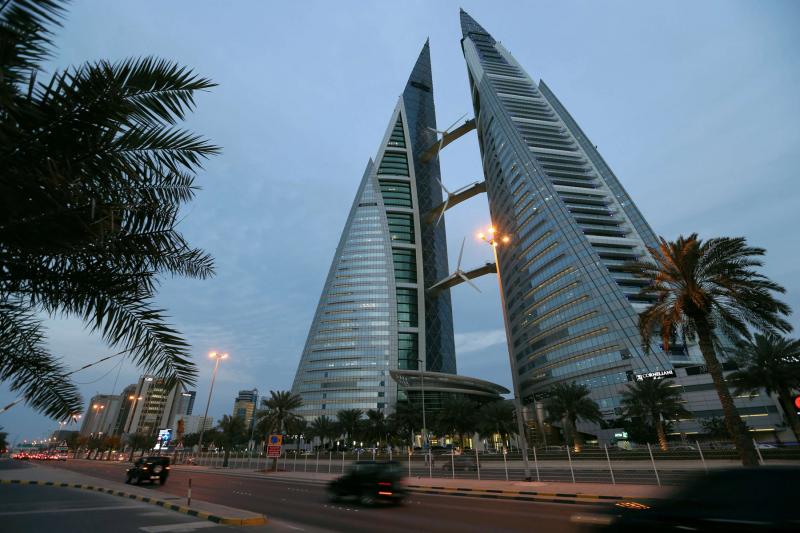
MANAMA: Bahrain has ranked 15th overall among the world’s most competitive emerging markets and seventh in the area of business fundamentals, according to the annual Agility Emerging Markets Logistics Index.
The index, now in its 12th year, ranks 50 countries by factors that make them attractive to logistics providers, freight forwarders, shipping lines, air cargo carriers and distributors. China, India and Indonesia topped the index, while three Gulf countries made the top 10: the UAE (4), Saudi Arabia (6) and Qatar (9).
In the area of business fundamentals, Gulf countries dominated the top spots. The UAE was No 1, followed by Saudi Arabia (3), Qatar (4), Bahrain (7), Oman (8) and Kuwait (11).
Nearby Jordan was 10th. China, India and Indonesia rank highest for domestic logistics; China, India and Mexico are at the top for international logistics.
“Gulf countries are pushing hard to diversify and integrate their economies by developing world-class infrastructure and creating fair, transparent conditions for business,” says Agility Global Integrated Logistics (GIL) Middle East and Africa chief executive Elias Monem.
“Good infrastructure and stable business conditions are areas of huge competitive advantage for the Gulf region. They will be key to recovering from the economic downturn brought on by the pandemic.”
The regional Gulf economy could get a boost as a result of the breakthrough that led to a resumption of diplomatic relations between the Arab Quartet and Qatar after three years.
That could lead to tighter integration in a region where cross-border trade, trucking and e-commerce are growing dramatically.
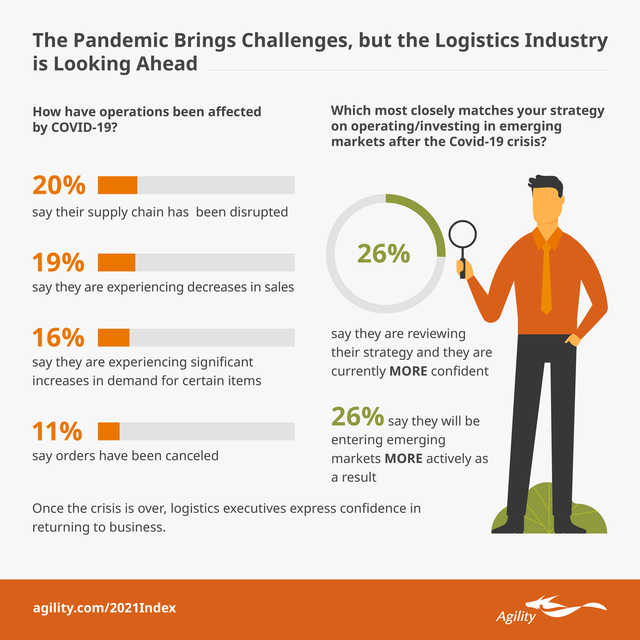
Along with the Index, Agility surveyed more than 1,200 supply chain professionals for their views on the disruption caused by the Covid-19 pandemic.
Of the executives surveyed, 44.7 per cent see a Middle East/North Africa recovery in 2021; 38.9pc say a recovery for the region won’t take place until 2022-2024.
While total cost is driving overall shifts in production supply chains, today low-cost labour is barely a consideration for emerging markets investment – with only 2.2pc of industry executives saying it’s important. Executives say the most important factors are government bureaucracy and regulation (25.8pc); infrastructure quality (14.1pc); and supply of skilled labour (8pc).
As companies examine new production locations, they say their biggest concerns are inadequate infrastructure (14.5pc) and additional cost (13.5pc).
Of the executives surveyed, 19.1pc say 2020 sales decreased as a result of the pandemic. But only 9.4pc say Covid-related employee safety measures have decreased efficiency.
The sustainability movement has momentum. More than a quarter (26.9pc) of executives surveyed say their companies are boosting implementation of environmentally sustainable practices in the wake of the pandemic. Another 45.2pc say their plans are unchanged, suggesting they have no intention of retreating from sustainability commitments.
The index was compiled by logistics research firm Transport Intelligence (Ti) whose chief executive John Manners-Bell said: “The strength of the index has always been to differentiate between those emerging markets which demonstrate resilience in the face of adversity and those which are more fragile. A lack of global demand, combined with the breakdown of air and sea logistics networks, has had severe consequences for these economies and societies. As the Covid-19 crisis finally unwinds over the next two years, those most resilient will bounce back the fastest. Inevitably, those which have failed to embrace market, trade, governmental and social reforms will be hardest hit by the fallout from the pandemic.”
avinash@gdn.com.bh
(2).jpg)
(1)(1).jpg)
&uuid=(email))