

ELECTRIC scooters are posing serious risks to the users and the general public, warned authorities.
These gadgets are sold in Bahrain and used by both children and adults on main roads and even on major highways.
The Interior Ministry has said that using the electric scooter by children in safe places is the responsibility of the parents, while the Industry, Commerce and Tourism Ministry has said that these gadgets were “not considered as toys”.
Children and adults have been seen using all three types of electric scooters – the electric kick scooters, self-balancing e-scooters and electric mopeds – as well as skating shoes.
However, the legalities governing their usage remain unclear.
“Using the electric scooter by children in a safe place is the responsibility of the parents,” said the Interior Ministry’s General Directorate of Traffic traffic awareness branch head Captain Kholoud Yahya.
A poster of the directorate’s safety campaign on educating children when using the electronic board (scooter) and bicycles in the summer was accompanied by a video showing very young children riding e-scooters – both self-balancing and electronically controlled – on major roads.
The directorate also cautioned bikers performing acrobatics on busy roads, with residents strongly voicing their concerns about the safety of the users and others.
Meanwhile, an Industry, Commerce and Tourism Ministry representative told the GDN that these scooters cannot be sold as toys. However, e-scooters costing BD50 and above are available in Bahrain as well as online.
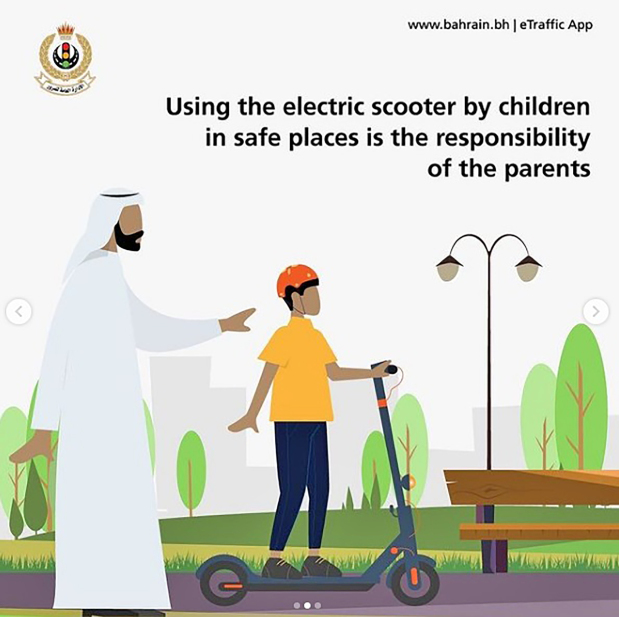
A safety campaign poster by the Traffic Directorate
“As per the ministerial order No. 1 for 2015 regarding the adoption of the children toys’ technical regulation, the e-scooters and other means of transport designed for sport or which are intended to be used for travel on public roads or public highways, the electrically driven vehicles which are intended to be used for travel on public roads, public highways, or the asphalt thereof are products that, in particular, are not considered as toys within the meaning of this directive or technical regulation,” said the representative.
“These products are not subject to the control of the ministry’s Testing and Metrology Directorate, but may be subject to the control of other regulatory government bodies.
“The risks to these products should be analysed and examined by the relevant regulators. Therefore, the Testing and Metrology Directorate will raise this subject through the relevant national technical committee for further discussion.”
The New Zealand Medical Journal this year cited that risk for e-scooter riders was about four times higher than for cyclists.
It is illegal to ride such scooters on public roads in many countries, because of it lacking visible rear red lights, number plates or signalling ability.
In the UK, e-scooters cannot be ridden on a public road, cycle lane or pavement, but can only be used on private land.
People who spoke to the GDN expressed grave concern about the rising number of e-scooters, boards and skaters on public roads.
“It is so scary to see these children – as young as 10 years old, using these gadgets on main roads where cars are speeding,” said Asma Ali, a university student from Riffa.
“They don’t have to even be hit by a car to cause an accident, all it needs is they slip or lose balance and crash on to the road.”
An Indian woman echoed similar sentiments, noting that she saw a young boy on the gadget exiting old Juffair road, in the wrong direction.
“Firstly, construction work is going on in the area and it is congested,” she said.
“This boy was casually exiting in the opposite direction on to the main highway and with ease crossed over to enter Palace Avenue; the cars were honking at him and he was laughing.
“We need strict laws to control the illegal usage of these gadgets.”
raji@gdn.com.bh
&uuid=(email))