

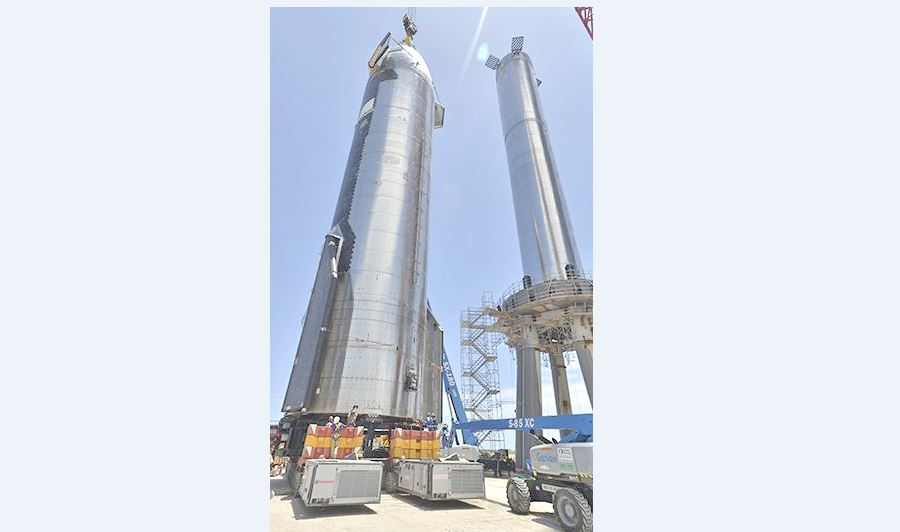
The American SpaceX company has stacked the biggest rocket ever constructed.
The vehicle’s two segments – an upper-stage called Starship and a booster called Super Heavy – were connected together at the firm’s Starbase R&D facility in Boca Chica, Texas.
Standing roughly 120m in height, it dwarfs any previous rocket system.
When it eventually lifts off, it will produce about twice the thrust of the vehicles that sent men to the Moon.
The main engines on Apollo’s famous Saturn V rockets delivered some 35 meganewtons off the pad. The new SpaceX Super Heavy should achieve around 70 meganewtons.
A massive crane was needed to join the two segments together. They were held in position for an hour before then being separated again.
SpaceX still has weeks to months of testing ahead of it to prepare for the inaugural flight.
This will see the booster hurl the Starship into space for a once-around-the-Earth trip, which will end with a disposal “landing” in waters off the Hawaiian islands in the Pacific. The Super Heavy will be ditched in the Gulf of Mexico.
Ultimately, though, SpaceX wants both segments of future vehicles to make controlled touchdowns, on land or on sea platforms, so they can be re-used.
Company CEO Elon Musk says the Starship system, once fully developed, will be more than capable of taking humans to the Moon and Mars.
&uuid=(email))