

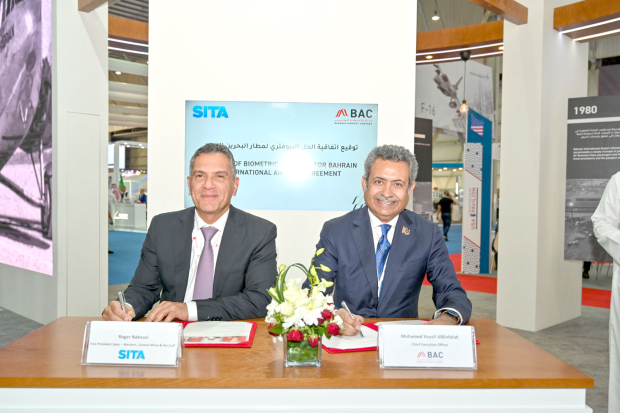
New biometrics technology will be introduced at Bahrain International Airport (BIA) allowing passengers to use their faces as their boarding passes.
This will result from an agreement between Bahrain Airport Company (BAC), the operator and manager of BIA, and SITA, a IT services provider for the air transport industry, signed yesterday by BAC chief executive Mohamed Al Binfalah with SITA vice-president for sales Roger Nakouzi.
The technology will not only make passenger processing faster and more efficient, but will also add an extra level of security.
Also present at the signing on the second day of the Bahrain International Airshow 2022 at Sakhir Airbase were BAC vice-president for information, communication and technology Mahmood Al Siddiqi, and other officials from both companies.
Mr Al Binfalah commented: Introducing this new biometric solution will further enhance the passenger experience, enabling travellers to pass through checkpoints faster and with less staff involvement, while ensuring every passenger who boards is who they say they are, with no room for human error.”
According to him this will enhance the state-of-the-art ICT systems and infrastructure at BIA, which is already “the most technologically advanced, efficient, and sustainable boutique airport in the Middle East”
He added that the implementation is part of BAC’s plans designed to enhance efficiency, improve security, and meet passengers’ growing expectations for a more seamless airport experience.
Also commenting was Hani El Assaad, president, Middle East and Africa (MEA), SITA, said: “We’re excited to collaborate again with BIA by implementing our industry-leading SITA Smart Path biometric solution, a whole-journey identity management solution where a passenger’s face becomes their boarding pass.
“Once biometrically enrolled, there’s no need to show a passport or boarding pass or touch a device again. From easy check-in at the kiosk to gate access and boarding, the solution will integrate into BIA’s existing systems, enabling them to process more passengers more efficiently.
“It also allows airport real estate to be used more effectively, improves social distancing among passengers, and offers greater operational efficiency and visibility for BIA’s stakeholders.”
avinash@gdnmedia.bh
&uuid=(email))