

An average of 250 Bahraini children per year are reportedly born with some form of cardiac abnormality, according to medical experts.
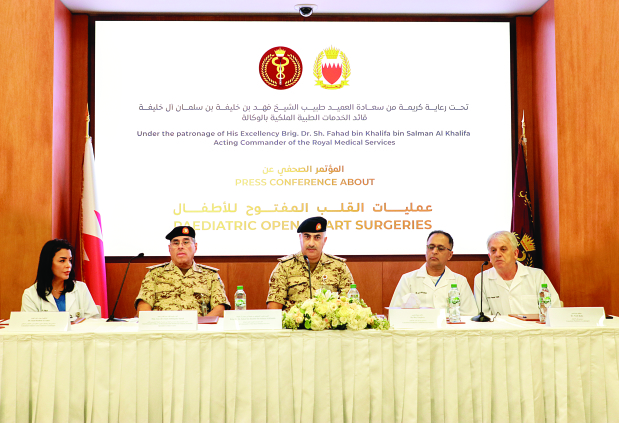
This was highlighted by a panel of medical professionals at a conference about paediatric open-heart surgeries, held at the Mohammed Bin Khalifa Bin Salman Al Khalifa Specialist Cardiac Centre (MKCC) in Awali yesterday.
The conference was held under the patronage of Brigadier General Dr Shaikh Fahad bin Khalifa bin Salman Al Khalifa, Acting Commander of the Royal Medical Services for BDF hospitals.
“Since the opening of the Shaikha Moza bint Hamad Al Khalifa Unit for the Treatment and Surgery of Heart Diseases for Children in March, 2022, 117 open-heart surgeries for children have been performed at the centre, with, potentially, more coming as we look to boost medical tourism in Bahrain,” he said.
“They were held in Bahrain for the first time ever, under the supervision of a team of specialists, and I’m happy to say that all of them were successful.”
An open-heart surgery is a procedure to treat cardiac problems by directly accessing the organ through an opening in the chest. The surgeon cuts through the breastbone and spreads the ribs to access the organ.
It is used mainly to treat congenital heart diseases such as septal defects, coarctation of the aorta – a narrowing a part of the body’s main artery – pulmonary valve stenosis, transposition of the great arteries and underdeveloped hearts.
Symptoms include rapid heartbeats or rapid breathing while the child is breastfeeding, swelling of the legs or around the eyes and fatigue.
It is known to be more present in children with Down syndrome and those whose mothers were ill with rubella during pregnancies, or were on certain medication.
Many cases of congenital heart disease are diagnosed before a baby is born during an ultrasound scan in pregnancy. However, it’s not always possible to detect congenital heart defects in this way.
MKCC consultant paediatric cardiothoracic surgeon Dr Roy Varghese said most of the surgeries were performed on infants, some not even one year old.
“Our youngest patient was barely 14 days old,” he said. “It was a delicate procedure with no room for error, but it was a success.”
Consultant paediatric cardiologist Dr Neale Kalis added that among the Bahraini children born with heart abnormalities not all of them needed to be rushed to the operating theatre.
“Only about half need surgery before their first year,” he said. “Minor conditions can often be treatable without it and some procedures can also be safely delayed until they turn three years old.
“Regardless, 250 is a very high number in my opinion and it is important to deal with the root of the issue before it worsens.”
Consultant paediatric interventional cardiologist Dr Suad Al Amer said the high number may stem from social and medical issues among pregnant women in the country.
“Diabetes commonly affects pregnant women,” she said. “It can cause heart issues in a developing child, especially if it is not treated properly.
“Social issues such as marriage between relatives is also a cause, especially if one of the parents has a genetic predisposition for it. Other than that, women getting pregnant late in their lives, and external environmental factors such as air pollution, can also be a cause.”
MKCC chief executive Major General Dr Fuad Abdulqader Saeed said the centre remains open to not just Bahrainis, but also other GCC citizens.
“This can be a major boost to medical tourism,” he added. “We welcome children and parents from all over the GCC and the MENA region for consultations, and we will work towards what is best for the child.
“The centre will continue to develop and we will always strive to have the best trained personnel possible.”
nader@gdnmedia.bh
&uuid=(email))