

A new accord between Bahrain and the US will help in regional integration of air and missile defence systems and increase maritime domain awareness to thwart emerging or existing threats.
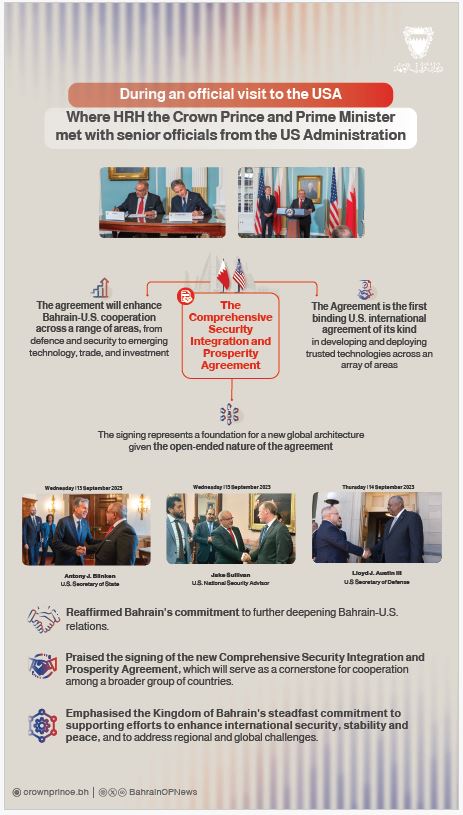
His Royal Highness Prince Salman bin Hamad Al Khalifa, Crown Prince and Prime Minister, signed the historic Comprehensive Security Integration and Prosperity Agreement (C-SIPA) on Wednesday in Washington with US Secretary of State Antony Blinken, as reported in the GDN.
Details of the landmark framework revealed it will enhance deterrence, boost commercial and economic ties and development of trusted technologies, including digital and Information and Communication Technology.
In addition, plans were announced to start direct flights between Bahrain and the US by next summer.
“Bahrain is one of the United States of America’s longest and closest partners in the Middle East, host to the US Navy’s Fifth Fleet, a major non-Nato ally, and a major security partner,” said a White House statement.
“To build on these ties, the Administration is launching the Comprehensive Security Integration and Prosperity Agreement with Bahrain – a new framework to promote co-operation across a range of areas, from defence and security to science, technology and trade.”
The Crown Prince and Prime Minister’s visit to Washington is the culmination of nearly a year’s worth of diplomatic engagement, including multiple trips to Manama by senior US officials.
It also follows HRH Prince Salman’s visit to Washington last year and his meeting with Vice President Kamala Harris.
The C-SIPA further formalises co-operation “to deter conflict in the region, enhance regional stability, de-escalate tensions, and bolster trade and economic co-operation – including through the development and deployment of advanced technologies with trusted vendors,” the White House statement added.
The agreement follows the announcement last week at the G20 of a transformational economic corridor between India, the Middle East, and Europe, the development of which will open unprecedented opportunities for the Gulf region, which serves as an economic engine and gateway between continents.
“C-SIPA is the latest manifestation of the US’ enduring commitment to Bahrain and to the region in support of peace and shared prosperity,” added the statement.
“After two decades of major conflicts in the Middle East region, the American people benefit from a region that is more peaceful, more secure, and more integrated internally and with the broader global economy.”
C-SIPA will deliver on that goal by:
1) Enhancing deterrence, including through expanded defence and security co-operation, interoperability, and mutual intelligence capacity-building. C-SIPA will help formalise steps being taken by US Central Command to integrate the region’s air and missile defence systems and increase maritime domain awareness.
2) Promoting co-operation on trade and investment, building on the existing US-Bahrain Free Trade Agreement.
3) Encouraging investments in global supply chain resilience and infrastructure.
4) Promoting development and deployment of trusted technologies, including ICT infrastructure supply chains, to support secure and resilient global telecommunications networks.
C-SIPA is the first binding US international agreement of its kind to promote co-operation in developing and deploying trusted technologies – a critical feature of today’s international security environment.
The US established official relations with Bahrain in 1971, but America’s cultural and social ties with Manama go back to the 19th century and the arrival of American missionaries who built a school, hospital, and church – all of which are still in operation today.
Defence and Security Co-operation
Bahrain hosts the Navy’s Fifth Fleet and the headquarters of the US Naval Forces Central Command (NAVCENT). The kingdom hosts thousands of US service members and is the only country in the US Central Command region to host military spouses and families. It is also a member of the 38-nation Combined Maritime Forces and the 11-member International Maritime Security Construct. The US military’s presence in Bahrain dates back to the Second World War. This presence has advanced US interests by keeping vital commercial shipping lanes safe, deterring threats, and enabling broader coalitions to operate.
Bahrain was the first Gulf country to receive F-16s in the 1990s. Bahrain took delivery of the first of 16 F-16 Block-70 fighter jets last March. In doing so, it also became the first customer to receive the latest generation Block 70 aircraft, a purchase that will nearly double the size of Bahrain’s F-16 fleet.
Bahrain was the first regional partner to work with the US Navy on integrating new unmanned systems and artificial intelligence after NAVCENT established Task Force 59 in September 2021. Last year, Bahrain committed to partnering with regional countries and the US to build a multinational fleet of 100 unmanned surface vessels.
NAVCENT and Bahrain conduct an annual large-scale bilateral military exercise with a specific focus on the maritime domain. The next iteration of this exercise, Diamond Defender 2024, will focus on maritime domain awareness, as well as command, control and communication, while integrating manned and unmanned capabilities.
Regional Integration Collaboration
Bahrain has been instrumental in supporting a regional vision of de-escalation and broader integration, including within the GCC and other countries in the Middle East.
Bahrain will benefit from the India-Middle East-Europe Economic Corridor that was announced at the recent G20 meeting in India, with a vision to connect ports and rail lines across continents to open new markets and enhance trade throughout the region.
Bahrain normalised relations with Israel in 2020 and has welcomed a series of senior Israeli leaders, business people, healthcare experts, and youth to Bahrain. More recently, the Negev Forum brought together Arabs and Israelis, including the largest gathering since the 1990s, to deepen co-operation and explore new ones.
Commercial and Economic Ties
Bahrain is a valued economic partner, and a Free Trade Agreement with the US came into force in 2006. Since then, bilateral trade has more than tripled from $780 million to nearly $3 billion last year.
Last year, Bahrain inaugurated a US Trade Zone where US companies can develop new products and reach untapped markets, adding to supply chain resiliency.
During HRH Prince Salman’s visit to the US, both countries had set a target for launching direct flights between the US and Bahrain by summer 2024. The US Federal Aviation Administration will begin work with the Bahrain Civil Aviation Authority this month to prepare for a safety assessment that, if successful, will pave the way for direct flights between the two countries.
Gulf Air has purchased 12 Boeing 787 Dreamliner aircraft to service long-haul routes, including three configured to serve routes to the US. Boeing has already delivered eight aircraft and two more are scheduled for delivery this fall, with the rest to be handed over in the coming years.
Both sides committed during the visit to exploring ways of co-operating on commercial, advanced small modular reactors (SMRs) as part of Bahrain’s clean energy transition. SMRs are a key part of the President Biden and Ms Harris’ Administration’s goal of addressing climate crisis through accelerated deployment of innovative, zero-carbon technologies.
Bahrain became the first Global Entry partner country in the region last year with US Customs and Border Control. Since then, many Bahraini travellers have qualified for expedited, secure travel to the US.
Governance and Human Rights
Human rights are a key part of the US-Bahrain Strategic Dialogue. The most recent dialogue took place last July, and was co-chaired by Secretary Blinken and Foreign Minister Dr Abdullatif Al Zayani. This format has enabled both countries to engage in constructive dialogue on the importance of universal values, human rights, and fundamental freedoms. Promoting human rights was also an important topic of discussion during the Crown Prince and Prime Minister’s visit to Washington this week.
&uuid=(email))