

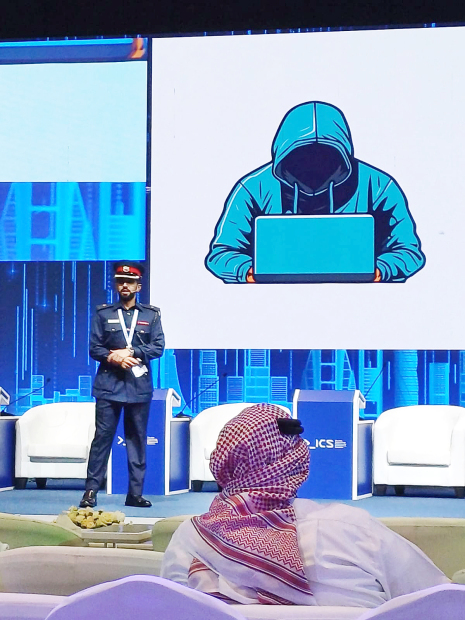
THE most common scams in Bahrain involve BenefitPay, according to an expert.
The best way for people to deal with scammers is educate themselves about preventive measures, said Interior Ministry head of financial crimes Mohamed Alabdulla.
He was speaking during a keynote session, titled ‘The Art of Cyber Fraud’, at the Arab International Cyber Security (AICS) conference, held at Exhibition World Bahrain in Sakhir.
Mr Alabdulla also noted that people should constantly update themselves on the different scams making the rounds so as not to lose their hard-earned money to fraudulent methods.
“Scammers are very good at taking advantage of people who don’t know any better,” he said.
“That is why they try to take advantage of elderly people or those who are technologically challenged.
“By understanding their methods, you can arm yourself with knowledge and protect your money and yourself.”
Among the most common scams that make the rounds in Bahrain is the BenefitPay scam. Users receive either a text or a phone call from a so-called employee of the online payment application, and are redirected to a link where they are conned into giving up their bank details.
Mr Alabdulla gave the audience an insight into their methods, and what happens after they successfully scam someone.
“The scam does not end just because they got the victim’s money,” he said.
“They can take up to BD1,000 from BenefitPay, and when they do, they start transferring the money to other accounts, usually belonging to someone working alongside them.
“It can be multiple accounts, which makes the money difficult to track, and almost impossible to retrieve.
“This can also be done using banking applications and other electronic wallets and gift cards.”
Also discussed were investment scams, where victims are tricked into giving up their money for a non-existent business opportunity.
“They get a call where the scammers tell the victims that they can teach them how to invest the money wisely,” said Mr Alabdulla.
“They start out with what seems like a reasonable amount, and send a link to the victims to ‘register’ with them.
“The main aim is to get the victim to trust them into depositing more and more money with them until they reach their limit.
“If necessary, they will allow the victim to withdraw an amount back into their original account, to throw them off.
Demand
“Once they believe that the victim has reached his limit, they transfer the money to an overseas account.”
The scam, however, does not end there, with scammers continuing to attempt to milk as much as possible using multiple steps.
“The scammers call again, this time pretending to be a lawyer who can get them their money back with his ‘connections’, demanding ‘legal fees’ in return.
“Then they pretend to be the police, and again demand a fee for getting the money back. It goes on and on.”
Another scam highlighted was one that utilised artificial intelligence (AI). Fraudsters find a video of a person discussing a financial topic, and using AI, doctor the video to make it seem as if they were talking about an entirely different subject.
“These videos are then uploaded online in the form of adverts that come with a link,” said Mr Alabdulla.
“And then, as usual, people who click on the link and enter their private details end up losing their money.
“This is fairly new, so not a lot of people know about it.”
The final fraud Mr Alabdulla discussed was a donation scam, where a ‘wealthy person’ reaches out to the victim and asks them to ‘donate’ the money on their behalf.
“In order to get the money, they are asked to go to an exchange or transfer place, and ask them to pay the ‘transfer fees’ in return for a large sum of money.
“They repeat the process over and over with the same victim, asking them to go to multiple places, with some people paying as much as BD3,000 to the scammers in return for money that will never come.”
According to Mr Alabdulla, the best method for combating such scammers is to educate people.
“Do not click on any links or give your private information to anyone.
“Understand how scammers work, how they operate, and most importantly, if something seems too good to be true, it probably is.”
nader@gdnmedia.bh
