Victims of crime look set to receive an admission of guilt, alongside an apology and suggestions on ways an offender could redeem for their illegal actions, in a pioneering new justice development.
Members of the community should get more involved in restorative justice processes in order to build bridges and increase reconciliation and rehabilitation, a major forum heard.
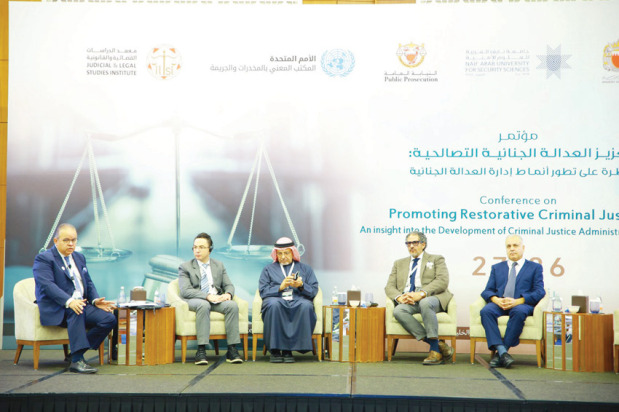
Speaking during the two-day ‘Conference on Promoting Restorative Criminal Justice’, held at the Gulf Convention Centre in Manama on January 26 and 27, a panel of experts stated that encouraging the practice could reduce the number of prisoners and solve problems at the earliest stage.
“When human dignity is preserved, rights are respected and fairness prevails,” said Attorney General Dr Ali Al Buainain. “It is important for the community to foster ideas, present solutions and produce recommendations to bolster ties with each other, and to give offenders a second chance.
“People need to show tolerance and understanding towards others, keep their minds open to reconciliation and work at finding a resolution perhaps before the issue reaches court.
“Additionally, people should give those trying to reintegrate into society a chance to better themselves and build a new life for themselves.
“So far, the people of this country have proved themselves admirable and are more often than not, willing to show compassion and empathy, so I am confident that in the coming years, restorative justice will play a bigger role.”
The session, titled ‘The Concept of Restorative Criminal Justice’ featured insights from Dr Al Buainain, Supreme Judicial Council vice-president and Cassation Court president Shaikh Khalid bin Ali Al Khalifa, legal philosopher and a restorative justice expert Dr Theo Gavrielides, University of South Wales professor Dr Ali Wardak and United Nations Office on Drugs and Crime representative Hatem Aly.
“The implementation comes as part of the directives of His Majesty King Hamad and the support of His Royal Highness Prince Salman bin Hamad Al Khalifa, Crown Prince and Prime Minister,” said Shaikh Khalid during the session.
“Led by Interior Minister General Shaikh Rashid bin Abdulla Al Khalifa, Bahrain has become an advocate for policies relating to restorative justice.
“Initiatives such as alternative sentencing programme and the Open Prisons Programme represent a qualitative leap in the kingdom.
“Additionally, there are services such as family and child protection offices in police directorates that are tasked with conducting dialogue in disputes and strive to achieve reconciliation.”
Restorative justice is an approach that aims to repair the harm done to victims by ensuring that offenders take responsibility for their actions.
It aims to make offenders understand the harm they have caused, to give them an opportunity to redeem themselves, and to discourage them from causing further harm.
For victims, the goal is to give them an active role in the process, and to reduce feelings of anxiety and powerlessness.
Dr Al Buainain stated that Bahrain has worked ‘diligently and sincerely’ to develop legislation relating to restorative justice in the kingdom, and is encouraging members of society to be actively involved in the process.
Dr Wardak recommended ways to enhance restorative justice processes in the country, highlighting the importance of involving the community in legal proceedings.
“A crime does not just affect the victim, it instils fear in the community,” said Dr Wardak. “Thus, the first step is to recognise the fears of the community and acknowledge that people are directly and indirectly impacted by criminal acts.
“It is also important to use local knowledge of the community to try to understand why the crime happened, why the conflict arose and to come up with solutions together.
“By having them directly involved in the process, you build a sense of accountability and ownership, find solutions that will improve the well-being of victims and offenders, and encourage the fulfilment of collective responsibilities.”
nader@gdnmedia.bh
Top stories for today:
GCC railway network plans on track
3,000 attend traditional harvest festival celebrations
Call to promote restorative criminal justice systems