

Bahrain’s proactive approach to tackle air pollution and reduce emissions through a series of initiatives is yielding results, with a new international report revealing the country’s positive indicators.
Swiss technology company IQAir has released its Annual World Air Quality Report 2024 that ranks countries based on their poor air quality.
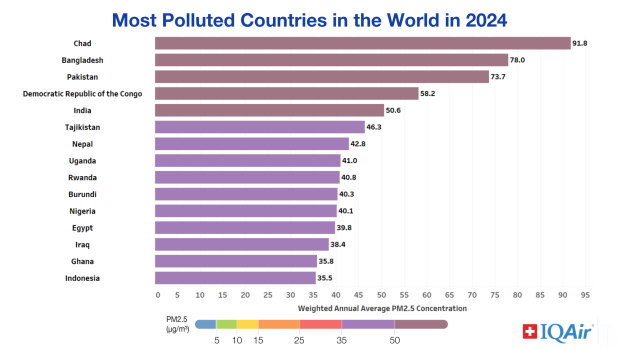
The comprehensive report presents PM2.5 air quality data (annual World Health Organisation air quality guideline) collected from 8,954 cities across 138 countries, regions and territories. It was sourced from more than 40,000 regulatory air quality monitoring stations and low-cost sensors, operated by a diverse range of entities, including government agencies, research institutions, non-profit organisations, schools, universities and private sector companies.
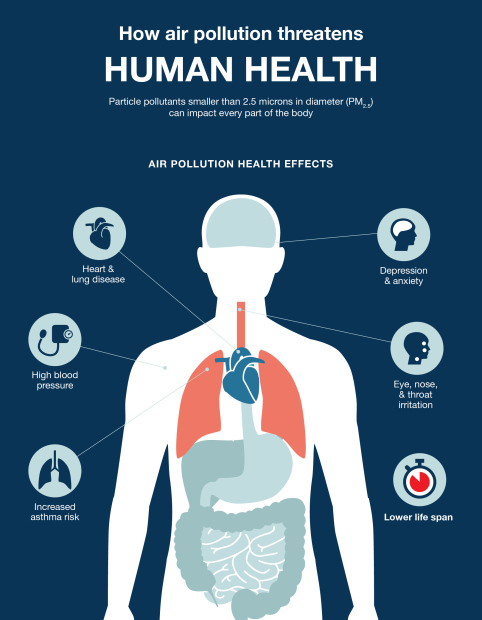
PM2.5 – fine particulate matter of 2.5 micrometres or less in diameter – is the most dangerous pollutant because it can penetrate the lung barrier and enter the blood system, causing cardiovascular and respiratory disease and cancers.
The concentration of an air pollutant is given in microgrammes per cubic metre of air, or µg/m3.
In the latest report, five GCC states are ranked among the top 35 countries that have high PM2.5 concentration (μg/m³). UAE is ranked 17th with 33.7 µg/m3, while Bahrain is placed 18th with 31.8 µg/m3.
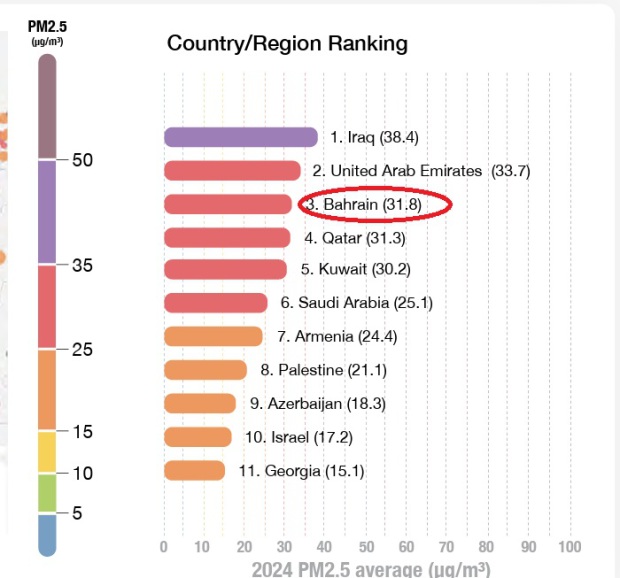
Bahrain has showed a notable reduction of 18 per cent in PM2.5 concentrations compared to 2023, when it was ranked 12th among 134 countries with 39.2 µg/m3. This year, the kingdom has moved up six spots in the latest air quality ranking.
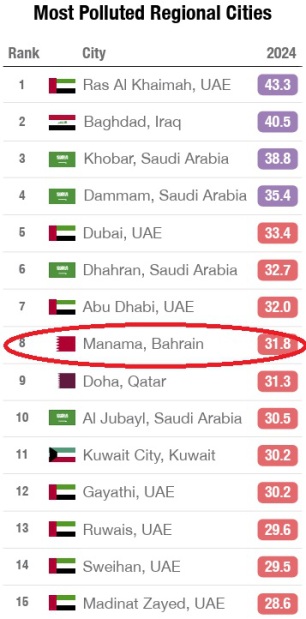
A lower µg/m3 value indicates good air quality as stated in the report. However, 31.8 µg/m3 is still 6.4 times the WHO annual PM2.5 guideline value.
In the 2022 report, the kingdom was among the five most polluted countries with 66.6µg/m3 which was more than 13 times higher than the WHO guideline.
However, Bahrain has been addressing climate change, setting it as a high priority in its policies.
The kingdom has committed to achieve the National Afforestation Plan’s goal of increasing greenery and doubling the number of trees by 2035. It includes quadrupling mangrove coverage and reaching carbon neutrality by 2060.
Meanwhile, in the latest report released yesterday, Qatar is ranked 20 (31.3 µg/m3) followed by Kuwait at 22 (30.2 µg/m3) and Saudi Arabia at 31 (25.1 µg/m3).
Gulf countries are classified under West Asia which includes 11 other nations. Oman is not included this year – despite being ranked as the sixth most polluted country in 2022 – due to lack of data availability.
The report states that West Asia showed moderate improvements, with PM2.5 levels dropping in each country across the region, although air pollution still remains a challenge.
Iraq (38.4 µg/m3) and the UAE (33.7 µg/m³) continued to rank among the most polluted countries in West Asia, with Iraq holding the 13th position and the UAE 17th.
“All other national capitals in the region met WHO Interim Target 1 levels, with annual average PM2.5 concentrations not exceeding 35 µg/m³,” the report said.
“Ras Al Khaimah, in the UAE, recorded the highest annual average PM2.5 concentration in West Asia at 52 µg/m3).”
However, no city in the region met the WHO annual guideline level for PM2.5. Approximately 36pc of monitoring stations in the region are in the UAE and 29pc are in Israel, states the report.
Key findings:
The report released yesterday shows that only seven countries met the WHO annual average PM2.5 guideline of 5μg/m3: Australia, Bahamas, Barbados, Estonia, Grenada, Iceland and New Zealand.
The five most polluted countries in 2024 were: Chad (91.8 μg/m3), Bangladesh (78.0 μg/m3), Pakistan (73.7 μg/m3), Democratic Republic of Congo (58.2 μg/m3) and India (50.6 μg/m3).
Byrnihat in India was the most polluted metropolitan area of 2024, with an annual average PM2.5 concentration of 128.2 μg/m3.
The most polluted major US city was Ontario, California while Seattle, Washington was the cleanest.
Mayaguez, Puerto Rico was the cleanest metropolitan area of 2024, with an annual average PM2.5 concentration of 1.1 μg/m3.
The report shed light on the scarcity of real-time, publicly accessible, air quality monitoring data in Africa as there is only one monitoring station for every 3.7 million people.
“Air pollution remains a critical threat to both human health and environmental stability, yet vast populations remain unaware of their exposure levels,” IQAir Global chief executive Frank Hammes said.
“Air quality data saves lives, it creates much needed awareness, informs policy decisions, guiding public health interventions, and empowers communities to take action to reduce air pollution and protect future generations.”
Mr Hammes added that schools were at the centre of communities, making them ideal locations for air quality monitoring.
“By outfitting schools worldwide with low-cost air quality monitors, more than seven billion people would have access to hyper-local, real-time air quality data, creating a worldwide movement for cleaner air.”
The GDN reported last year that Oil and Environment Minister Dr Mohammed Bin Daina told MPs that Bahrain’s air quality remains at normal levels and no indicators of major pollution registered.
He told legislators, in a written response to a question that the Supreme Council for the Environment (SCE) was monitoring emissions through conventional laboratories, samples, field visits and tests done by neutral environmental standardisation and emission measurement firms.
He added since the 1990s air quality in the country was measured round-the-clock through seven monitoring stations located in Galali, Sitra, Bahrain Fort, Ras Hayyan, Jasra, Zayed Town and Awali.
Plans are underway to install six new monitoring stations in the Muharraq, Capital and Southern Governorates.
Health challenges:
Air pollution is the second leading global risk factor for death.
It’s the second leading risk factor for deaths among children under five, after malnutrition, due to its significant impact on respiratory and developmental health.
In 2021 alone, 8.1 million deaths were attributable to air pollution.
Exposure to PM2.5 contributes to and exacerbates various health conditions, including asthma, cancer, stroke and lung diseases. In addition, exposure to elevated levels of fine particles during pregnancy and early childhood are associated with congenital heart defects, eczema and allergic disease, cognitive impairments and delays, neurodevelopmental disorders, and mental health disorders.
sandy@gdnmedia.bh
Top stories for today:
Grandmother on visit to kingdom passes away
Ukraine ready for 30-day truce plan
MPs seek to safeguard workforce
&uuid=(email))