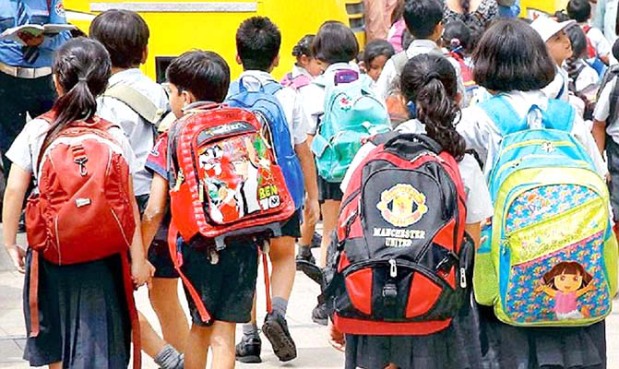
Bahrain has been urged to adopt the new guidelines for school bags issued by Saudi Arabia to safeguard children’s health.
MPs from the Strategic Thinking Bloc, led by Parliament’s financial and economic affairs committee chairman Ahmed Al Salloom, have submitted a proposal calling on the government to study the feasibility of implementing Saudi guidelines in Bahrain.
Saudi Arabia’s Education Ministry had recently issued a comprehensive awareness guide specifying the standards that school bags should meet to protect children from spinal and muscular injuries caused by misuse or poor design.
Among the recommendations are – a bag’s weight should not exceed 10 per cent of a child’s body weight, it should fit the body width, and feature padded cotton support to protect the spine.
The guidelines also stressed the importance of wide, cushioned shoulder straps and multiple compartments in bags to help distribute weight evenly. The backpack should also be made of lightweight material.
Mr Al Salloom said that Bahrain must follow suit without delay as ‘our children’s health comes first – before books, before grades, before anything else.”
“If the school bag that a student carries every day is harming their back, we are failing them as policymakers and as a society,” he told the GDN.
He added that the Saudi model was both practical and scientifically sound.
“These are not arbitrary recommendations. They are based on studies showing the long-term damage heavy and poorly-designed school bags can cause,” Mr Al Salloom explained.
“We want to study how this can be introduced in Bahrain quickly because every year we delay means another generation of children is carrying preventable risks on their shoulders ... literally.”
Mr Al Salloom stressed that the move was an investment in a healthy future.
“We spend millions treating back and posture problems later in life. By adopting these standards today, we will save not just money, but also the well-being of our future generations,” he noted.
“If approved, the initiative could see Bahrain joining a growing regional trend of prioritising student health in the classroom – starting with something as simple, yet vital, as the school bag.”

Stationary and school supplies distributed by Dr Al Dhaen to support families ahead of opening of schools
Bloc member MP Dr Mariam Al Dhaen, a co-signee on the proposal, stressed the importance of public awareness and co-operation between families and schools.
“Parents often think a bigger bag means better, or they choose based on design or price without realising the health consequences,” she said.
“We want to change that mindset.
“This is about educating families to look for the right specifications – weight, fit, padding, compartments and not just appearance.”
She also called on all educational institutions to be part of the solution.
“We will be recommending that schools co-operate by adjusting timetables and reducing the number of books students need to carry each day,” Dr Al Dhaen noted.
“Health and education are inseparable – a child who is comfortable and pain-free is a child who can focus better and learn more effectively.”
The proposal urges Bahrain’s Education Ministry to work with health experts and school administrations to issue guidelines similar to Saudi Arabia’s, and to launch an awareness campaign targeting parents and students.
It has been referred by Parliament Speaker Ahmed Al Musallam to the services committee for review with the Education Ministry.
A study conducted in Saudi Arabia, covering 300 students in Dammam City, revealed a significant correlation between the weight of school bags and the severity of shoulder pain among youngsters.
It called on authorities to set standards to prevent children from carrying heavy school bags in the intermediate school.
mohammed@gdnmedia.bh