

HOTELS, resorts and tourism establishments with water activities in Bahrain will undergo audits starting next month to ensure they are all compliant with the latest pool and beach safety standards.
The Royal Life Saving Bahrain (RLSB) released new guidelines back in July outlining new safety requirements for both beaches and pools in the country.
This was to enhance the safety of guests during their stay, with potential legal repercussions for those who fail to comply with the new guidelines.
In order to educate hotels and tourism accommodations in Bahrain, a week-long seminar is being held by the RLSB, led by general manager Sam Rahman, at the Bahrain International Exhibition and Convention Centre in Manama.
It is being held in co-ordination with the Bahrain Tourism and Exhibitions Authority (BTEA) and the Tourism Ministry.
During the occasion, he stated that these new guidelines are intended to give people the best possible chance, should a tragedy strike in the waters.
“Around the world, the average survival chance for drowning victims is around five per cent, in Bahrain, it is only 0.01pc,” Mr Rahman said.
“These new guidelines are not meant to scare people, but rather raise awareness of the importance of maintaining safety standards.”
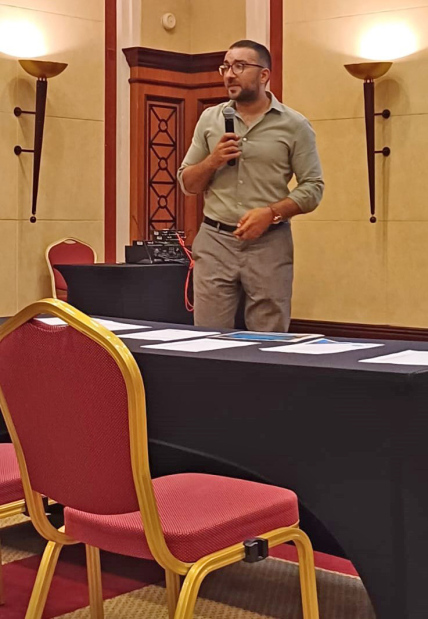
Mr Rahman speaking at the seminar
Mr Rahman highlighted some key issues with water safety in hotels around the kingdom, stating that most of them revolve around lifeguards or lack thereof.
“Some hotels are operating pools and beaches without lifeguards or an insufficient number of them,” he said.
“Many of them do employ lifeguards, but they are not trained properly or certified by the RLSB.
“There may also be insufficient safety signage or inadequate rescue equipment.”
As mandated by BTEA, all hotels, resorts and tourist establishments now must comply with Guidelines for Safe Pool Operations and Guidelines for Safe Beach Operations starting next month.
Establishments have been given a self-assessment checklist to conduct their own audits and give them the opportunity to ensure they are fully compliant.
According to these guidelines, a qualified lifeguard must be present during all pool operational hours. If a lifeguard is not available, the pool must be closed, and guests cannot be allowed access.
Each pool must have dedicated lifeguard coverage during operation. The number of lifeguards required depends on pool size, visibility, and occupancy.
Beach lifeguards must be properly trained, equipped with rescue boards/tubes, and stationed at designated lookout points. A clear communication and emergency response plan must also be in place.
The number of lifeguards required depends on the pool size. Pools with an area of 170 to 312 square metres should ideally have at least two lifeguards, 416sqm should have three, while 1,000sqm and above should have at least six on duty.
Lifeguards and designated safety personnel must be trained in CPR and first aid. It is strongly recommended that additional operational staff also receive training to strengthen emergency response capacity.
Additionally, clear signage regarding diving and child supervision policies should be put up in a visible area and should be up to international specifications.
Non-compliance may result in penalties, restrictions or suspension of pool/beach operations until corrective actions are taken, enforced by BTEA in collaboration with RLSB.
Mr Rahman warned against hiring non-certified lifeguards and also warned applicants against fabrication of RLSB certification.
“Recruit lifeguards that are already certified by RLSB or hold a valid certificate that is recognised by the International Life Saving Federation,” he said.
“If you are unsure, you may send the certificate to us for verification.
“Each certificate has the signature of RLSB founder and chairwoman Shaikha Nayla bint Hamad Al Khalifa, along with a special reference number.
“If you send the certificate to 32001113, we can confirm whether it is legitimate or not.
“I strongly advise applicants against fabricating these certificates, because we can find out in a matter of seconds, and you could face legal action for it.”
nader@gdnmedia.bh
&uuid=(email))