

.jpg?20260427')
Science, technology, education and math (STEM) students could see a boost in academic performance if artificial intelligence (AI) tools are integrated in their classrooms, according to recently published research conducted at the University of Bahrain.
The ‘Advancing Learning Outcomes in Physics Education through Artificial Intelligence Integration’ study found that students whose learning was enhanced with AI-assisted instruction and tools, outperformed those with traditional teaching by as much as 16 percentage points in test scores.
“The integration of artificial intelligence (AI) into Physics education has emerged as a prominent area of innovation in recent years,” lead author and UAE University associate professor of physics and materials science Adnan Younis explained. “This study investigates the influence of AI-based tools on student learning outcomes, conceptual comprehension and academic performance in four different introductory physics courses at the undergraduate level in the University of Bahrain.”

Mr Younis
The research, carried out over three academic semesters and involving 320 undergraduate students, explored how AI integration in physics courses impacted learning outcomes, engagement and problem-solving.
The results, published in the peer-reviewed ‘European Journal of Education and Pedagogy’, point to measurable improvements across multiple areas of student performance.
While most media reports around AI being used in academia point to its abuse as a tool to plagiarise and complete writing assignments on behalf of students, more research is now being conducted to investigate how it was be used as a complement to in-class teaching.
This study compared traditional teaching with AI-assisted instruction that incorporated tools such as ChatGPT to help students reflect and think critically about their learning, create interactive simulations and automate feedback systems for quizzes and tests.
One of the metrics for measuring impact was comparing learning outcomes between an AI-assisted group with a control group.
“The data reveals consistent improvements in the experimental group, with the most notable gains observed in Newtonian mechanics (82pc versus 68pc), followed by electromagnetism (80pc vs 64pc), waves and optics (79pc vs 66pc), and thermodynamics (77pc vs 62pc),” Mr Younis added.
“These results suggest that AI-supported learning methodologies contribute to enhanced conceptual understanding and problem-solving proficiency compared to conventional teaching approaches.
“The observed performance differentials, ranging from 12 to 15 percentage points across all topics, underscore the potential of AI integration in improving physics education outcomes.
“The superior performance of the experimental group can be attributed to the interactive and adaptive nature of AI-driven learning platforms.
“These tools provided immediate conceptual feedback and personalised scaffolding, which enabled students to clarify misunderstandings in real time.”
Beyond exam scores, students in AI-supported classes also displayed stronger problem-solving skills.
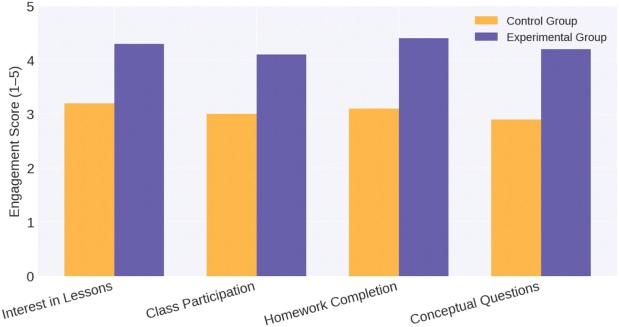
Student self-reported engagement levels during AI-enhanced vs traditional instruction
They were more accurate when working through multi-step problems and developed strategies for evaluating whether their solutions made sense.
According to researchers, the AI-supported environment enabled students to actively monitor their thought processes and make adjustments in real time, with the feedback loop promoting ‘a safe learning space where students could experiment with strategies, reflect on mistakes, and refine their approach without fear of penalisation.’
Students reported feeling less anxious when approaching difficult questions, crediting the responsive nature of AI tools. The paper highlighted that some learners gained confidence by engaging with technology that ‘explained concepts better than the book’ and made lessons ‘more fun and less intimidating.’
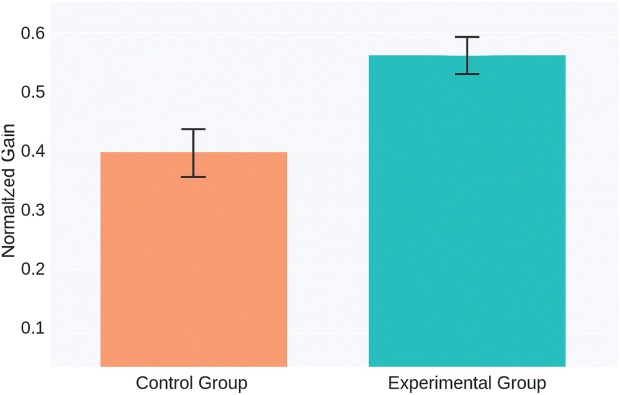
Conceptual understanding differences between the two groups, measured using pre- and post-instruction tests
The study also found that AI helped sustain student interest, a challenge often cited in large introductory courses.
Surveys showed higher engagement levels across areas such as participation, homework completion and conceptual questioning.
“AI tools positively influenced student engagement across multiple dimensions,” the study reported.
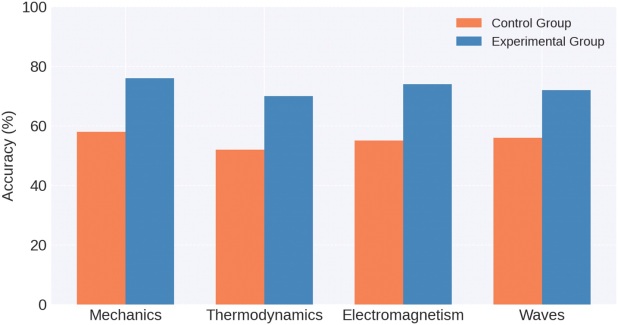
Students accurately solving multi-step physics problems in the control and experimental groups
Notably, students who were typically quieter in class appeared more willing to contribute during AI-assisted sessions. The anonymity and instant feedback offered by the tools helped reduce the anxiety of speaking up in front of peers, broadening participation. However, the study has also warned of potential drawbacks.
Over-reliance on AI for answers, exposure to inaccurate information, and the risk of widening the digital divide were among the issues flagged.
“Educators must strive to maintain a balance between leveraging AI support and fostering the development of students’ critical thinking skills,” the paper said, reiterating previous concerns around academic integrity, data privacy and algorithmic bias.
The study concludes that while challenges remain, AI has the potential to transform physics education and other STEM fields if implemented strategically.
“The evidence from this study supports broader adoption of AI in STEM education, with proper guardrails and pedagogical design,” Mr Younis concluded.
naman@gdnmedia.bh
&uuid=(email))