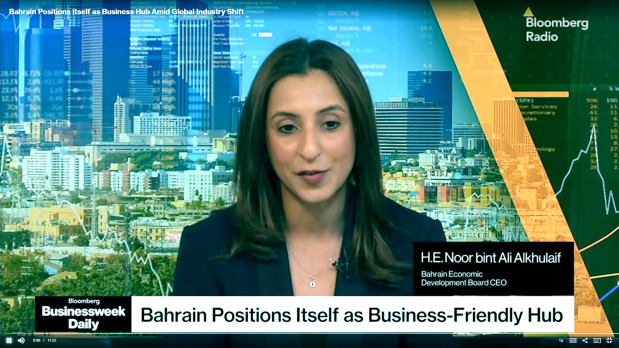
Bahrain is firmly focussed on establishing itself as a premier global technology and business destination, leveraging its business-friendly regulatory framework, cost-competitiveness and strategic location.
This was the core message delivered by Sustainable Development Minister and Bahrain Economic Development Board (EDB) chief executive Noor Al Khulaif during an appearance on Bloomberg Businessweek Daily.
Speaking with hosts Carol Massar and Tim Stenovec, the minister outlined the kingdom’s strategies for attracting and retaining major international corporations and their talent pools.
Ms Al Khulaif introduced Bahrain as a historic ‘strategic maritime state’ that has long served as a gateway and transit hub for the region, a role she noted continues to inform the country’s ‘business friendly’ ethos.
Dispelling a common misconception, she highlighted the significant diversification of the economy. “Our GDP is 85 per cent non-oil,” she said, with the financial services sector as the largest contributor, followed by manufacturing.
“The other strategic sectors that we focus on are tourism, logistics and technology,” she added, alongside education and healthcare. The minister noted that this diversification was achieved through ‘attracting investment into the country, being very open and allowing investors to come and take advantage of the region’.
Speaking from Los Angeles, where she was meeting with prospective investors, Ms Al Khulaif revealed that discussions spanned a variety of sectors, with a particular focus on technology.
“In Bahrain, we’ve always admired the technology sector of the US,” she said, detailing conversations with innovators and founders on supporting tech growth through Bahrain. She also mentioned meetings related to manufacturing and the film industry.
Addressing the competitive environment, particularly in light of countries increasingly looking inward, she maintained that the kingdom does not view international investment as a ‘zero sum game’.
“Some companies would need to have presence in both regions, not necessarily just one,” Ms Al Khulaif argued, noting that the rapid growth in consumer demand in the Middle East means many companies need a presence closer to their customer base.
The EDB’s approach, she explained, is to work closely with companies to understand their growth plans and ask: “How can we support you in the region and what can Bahrain do for you?”
When asked about the competitive landscape among Gulf nations, the minister acknowledged the excitement of regional economic visions but positioned Bahrain’s economy as complementary.
Ms Al Khulaif identified several key competitive advantages that distinguish Bahrain.
“First, cost competitiveness is a major factor; the country continuously monitors the costs associated with both setting up a business and the international relocation of staff, including expenses for schooling and healthcare. Second, its connectivity is a draw, as the kingdom maintains a free trade agreement with the US and has investment agreements with nations representing approximately 30pc of the world’s GDP. Finally, Bahrain operates under a ‘Team Bahrain Ethos’, where the government and private sector work as a single unit, which allows for agile regulatory responses to meet investor needs,” she explained.
A prime example of regulatory innovation was cited: in response to a request from Amazon Web Services (AWS), which established the Middle East’s first hyperscale data centre in Bahrain, the country introduced a data jurisdiction law. This legislation treats data hosted in Bahrain as an embassy, preventing access by Bahraini authorities and requiring a US court request – a move that significantly boosts investor confidence.
Addressing global issues around talent mobility, the minister stressed the importance of attracting international expertise. Bahrain recently launched the Golden Residency programme, a 10-year, automatically renewable visa for investors, retirees, entrepreneurs, and talent, which allows international companies to relocate personnel to the kingdom.
On the subject of high-tech infrastructure, she confirmed a strong focus on data, adding: “We’ve set up the first hyperscale data centre in the Middle East a few years back.” She also noted the presence of other tech giants like Oracle, IBM and Microsoft, and local investments, highlighting significant potential for further growth in AI data centres.
Finally, Ms Al Khulaif concluded by emphasising that while the current regional political turmoil is a factor, the countries in the region remain ‘very much focused on economic strategies’.
She reassured that Bahrain is ‘blessed to have a very stable and a safe business environment’.
avinash@gdnmedia.bh