

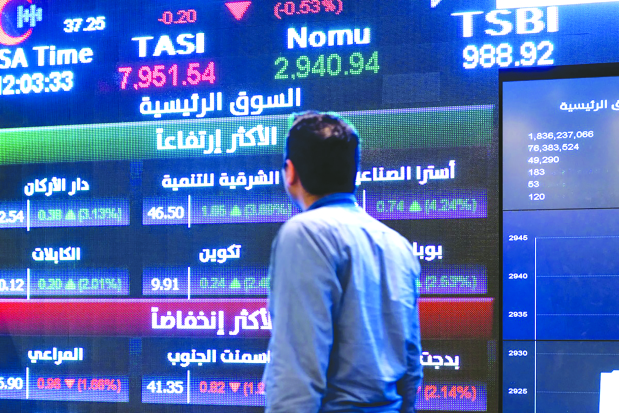
Most Gulf stock markets ended lower yesterday, led by Saudi Arabia, as oil prices slid more than $2 a barrel after the US and Iran agreed to hold talks in Oman.
Crude prices, a key driver for Gulf financial markets, tumbled 2.2 per cent with Brent trading at $67.93 per barrel.
Saudi Arabia’s benchmark stock index fell 1.3pc, snapping a three-session winning streak, with all constituents in negative territory. Declines were led by materials, IT and real estate.
Saudi Arabian Mining dropped 5.4pc and Saudi National Bank, the kingdom’s largest lender by assets, slid 2.7pc. Bank Albilad rose 0.8pc after posting higher full-year net profit on Wednesday. The Saudi index also logged a weekly loss of 1.8pc, as profit-taking set in after three consecutive weekly gains.
The benchmark Tadawul index opened at 11,320.52 and trended lower throughout the session, finishing well below its previous close of 11,341.27.
Market breadth was sharply negative, with only 28 gainers compared with 236 decliners. Trading activity saw a volume of 239 million shares exchanged, with total turnover reaching 5.5 billion saudi riyals ($1.47bn).
In the parallel market, Nomu closed higher, rising 0.23pc to 23,865.95, although decliners continued to outnumber advancers. The MT30 index closed at 1,508.60, down 1.46pc, shedding 22.38 points by the end of the session.
The Qatari benchmark index eased 0.3pc, with most stocks lower. Qatar National Bank, the region’s largest lender, fell 0.6pc and Gulf International Services dropped 1.2pc.
The Abu Dhabi benchmark index was marginally higher, as losses in utilities, healthcare and consumer staples outweighed gains elsewhere. National Bank of Umm Al Qaiwain rose 3.2pc after reporting a 15pc increase in full-year net profit, while Abu Dhabi National Energy Company fell 1pc.
Dubai’s benchmark stock index extended gains for a fourth straight session, adding 0.1pc to 6,675 – a fresh record high since 2006. Emirates NBD, Dubai’s biggest lender, gained 1.5pc and Emaar Development advanced 2.8pc.
In separate data, the UAE’s non-oil private sector logged the fastest growth in new business in nearly two years in January, driven by a sharp rise in new orders, a survey showed on Wednesday.
Outside the Gulf, Egypt’s blue-chip index rose 0.2pc, supported by an 8.1pc jump in Ibnsina Pharma and a 2.2pc gain in Fawry for Banking Technology.
On Wall Street the Dow Jones Industrial Average fell 489.19 points or 0.99pc to 49,012.11, the S&P 500 fell 61.34 points, or 0.89pc to 6,821.38 and the Nasdaq Composite fell 207.66 points or 0.91pc, to 22,696.92.
The pan-European STOXX 600 index fell 1.07pc.
In currencies, the dollar index, which measures the greenback against a basket of currencies including the yen and the euro, rose 0.14pc to 97.82, with the euro down 0.09pc at $1.1795.
In precious metals, silver and gold fell again.
Spot silver fell 12.81pc to $76.76 an ounce after earlier falling as low as $72.21, while spot gold fell 1.75pc to $4,875.65 an ounce.
&uuid=(email))