

Bahrain is stepping up efforts to position itself as a regional and global hub for higher education, with a new 10‑year strategy starting this year focused on international rankings, foreign university partnerships and easier student visas.
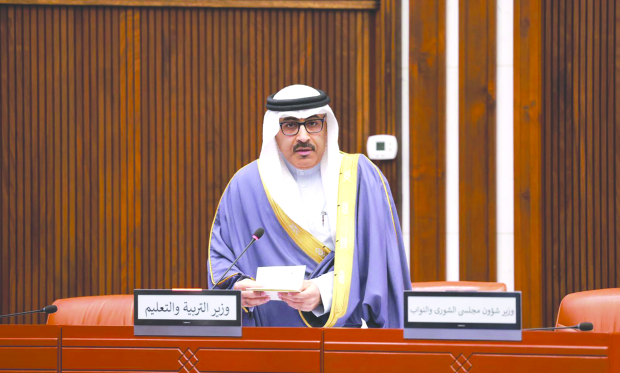
Education Minister Dr Mohammed Mubarak Juma outlined how the ministry and the Higher Education Council, which he is a board chairman of, are implementing integrated plans to make the kingdom one of the Gulf’s most attractive destinations for international students and academic investment.
“Bahrain has moved from traditional education development to a stage of global competitiveness,” Dr Juma said while responding to a parliamentary question by Shura Council member Nancy Khadoury.
“Our policies are now focused on international visibility, academic partnerships, quality assurance and creating an environment that attracts students and institutions from around the world.”
At the centre of the effort is the National Strategy for Higher Education and Scientific Research (2026-2036) which aims to strengthen Bahrain’s presence in international university rankings and expand cross-border academic co-operation.
Dr Juma said initiatives such as Study in Bahrain are being rolled out as part of a global promotional campaign to market the kingdom as a safe, high-quality education destination.
“We are not only promoting Bahrain abroad, but creating incentives for talented international students to choose Bahrain and remain connected to it,” he noted.
A major pillar of the strategy is the Bahrain TNE Hub (Transnational Education), which aims to attract prestigious foreign universities and programmes to operate from Bahrain, turning the kingdom into a host platform for global academic offerings.
This is already visible through the presence of international institutions such as British University of Bahrain (in partnership with the University of Salford), Royal College of Surgeons in Ireland - Medical University of Bahrain, and academic collaborations between local universities and institutions in the UK and US.
The minister highlighted that Bahrain’s recently enhanced student visa system has also made it easier for international students to study and reside in the kingdom, further boosting its appeal.
On the international front, Bahrain is actively represented at major education exhibitions and forums. The Higher Education Council participates in regional and global events, including education expos in the UAE, UK and China, while encouraging local universities to host international scientific conferences and send faculty to global research forums.
“Representation at international exhibitions is not symbolic,” Dr Juma stressed. “It directly translates into academic agreements, research co-operation, student mobility and institutional recognition.”
Bahrain’s higher education institutions are also members of international academic bodies such as the International Association of Universities and the Association of Arab Universities, ensuring global recognition and smoother academic co-operation.
Quality assurance remains a cornerstone of the strategy. The Higher Education Council links licensing and accreditation to performance reviews conducted in co-operation with the Education and Training Quality Authority and the National Qualifications Framework.
“This ensures that no institution or programme operates without meeting internationally benchmarked standards,” Dr Juma said.
The results, he added, are already measurable.
“Several Bahraini universities are now ranked in global classifications such as the Times Higher Education and the QS World University Rankings,” explained Dr Juma.
“More than 82 international programme accreditations have been secured, including ABET for engineering and AACSB for business studies, enabling graduates to work and pursue further studies abroad with ease.
“Bahrain has also signed mutual recognition agreements for higher education qualifications, most recently with Cyprus under Royal Decree No 20 of 2026, while Bahraini universities are listed among recognised institutions in several GCC and Arab countries, including Saudi Arabia and Jordan.”
The Higher Education Council uses three main benchmarks to measure progress – institutional and programme quality, scientific research and innovation, and internationalisation and academic mobility.
“Indicators include the number of accredited institutions, global ranking placements, growth in Scopus-indexed research publications, percentage of STEM students, number of foreign academic programmes hosted in Bahrain, and the proportion of international students,” he stressed.
“They are practical indicators showing how Bahrain’s higher education system is becoming more competitive and globally attractive year after year.
“Our goal is clear – to make Bahrain a recognised name on the global higher education map,” he added.
mohammed@gdnmedia.bh
&uuid=(email))