

Bahrain is playing a unique role at the helm of three regional and global diplomatic bodies, and is crucial to promoting international humanitarian law amid the ongoing Iran-US tensions, according to a top Red Cross official.
The kingdom is currently presiding over the UN Security Council for April, while also holding the GCC presidency for 2026 and chairing the Arab League Ministerial Council during its 165th session. Speaking exclusively to the GDN, International Committee of the Red Cross (ICRC) delegation head Mamadou Sow recognised Bahrain’s commitment to global humanitarian law.
“It’s very rare in the history of nations for one to have a triple responsibility – to be chairing the Arab League, presiding over the Security Council, and also the president of the GCC – and Bahrain has been doing that with flying colours,” he noted.
“And then it is equally rare to have those responsibilities and the challenges that are related to the latest escalation in the region.”
He added that the kingdom’s strong infrastructure and institutions ensured there would be no need for external humanitarian aid, and that his visit, which ended yesterday, was focused on emphasising the ICRC’s commitment to Bahrain in continuing to uphold its obligations to international humanitarian law.
“Bahrain has domesticated and ratified most of the important international treaties on humanitarian law,” he added.
“I work very closely with the Judicial and Legal Studies Institute, and we do a lot of training with judges, military, police and others, so that there is deep understanding of the law that is ratified and domesticated.
“Some of these have been even branded as a model for the rest of the region to follow.
“This is quite important at the global level.
“The Bahrain Red Crescent Society (BRCS) here is a very active member of our Red Cross and Red Crescent network around the world.
“And in the past couple of years, we’ve even received financial support from the BRCS for our operations around the world.
“When a Red Crescent or Red Cross organisation supports us, the value is counted in terms of money, and also in terms of how much they accept and respect our mission around the world, which is to assist and protect victims of war.
“Last but not least, Bahrain has also been quite essential in its current role in the Security Council. I conveyed my congratulations to (Bahrain Foreign Minister) Dr Abdullatif Al Zayani this morning on the landslide Resolution 2817 that was passed with the record of highest number of co-sponsors and countries that supported it, and most importantly, with the language of international humanitarian law embedded in the resolution and in the posture of Bahrain at the UN Security Council.”
Mr Sow praised the efforts of the BRCS in organising workshops in the aftermath of the attacks, focused on disaster management, evacuation, emergencies and psychological first aid. He also noted that discussions were ongoing to develop initiatives focused on children, as well as first responders and medics, to help them develop strategies to cope in difficult times.
Mr Sow emphasised the importance of following international humanitarian law, which calls on countries to spare civilians, respect their lives and dignity, and not attack civilian infrastructure.
“Today, in places like Bahrain, Kuwait and most places that are highly urbanised, infrastructure is interconnected,” he explained.
“When parties to the conflict attack this civilian infrastructure, they create a greater harm. And this is illegal. It’s prohibited under international humanitarian law, so in a moment like this, the role of the ICRC is really to stand as a defender, so that civilians are not affected indirectly or directly.”
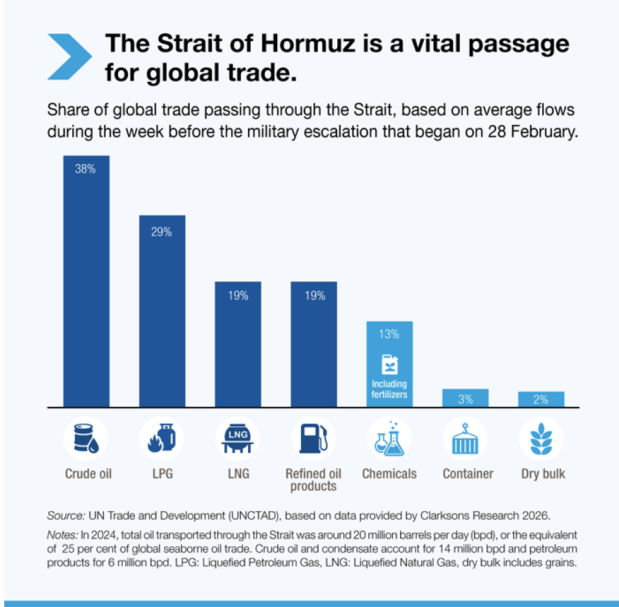
Primary products passing through the Strait
Mr Sow also spoke of how the conflict has already had a lasting impact on civilian lives and the distribution of humanitarian aid, primarily through the closure of the Strait of Hormuz.
According to the UN Conference on Trade and Development, the ongoing conflict affecting the Strait of Hormuz region is disrupting energy and fertiliser flows, with measurable impacts on costs and growing risks for food systems, trade and vulnerable economies.
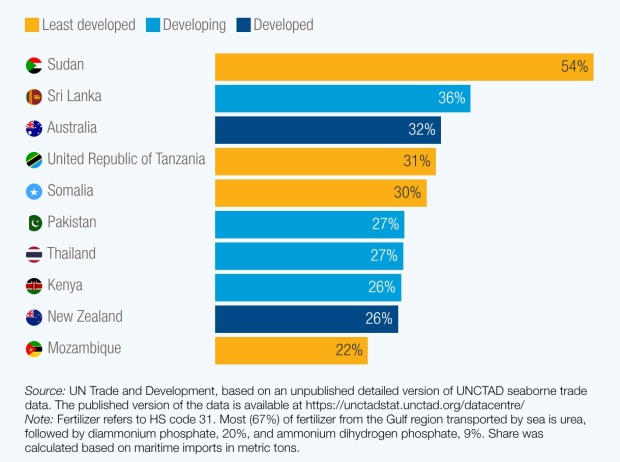
Share of fertilisers imported from the Arabian Gulf region in 2024
“Prices for nitrogen-based fertilisers have risen significantly, with smaller but noticeable increases in phosphatic fertilisers,” UNCTAD noted, in a recent Press release.
“The region’s role goes beyond energy. It is also a major producer of key inputs such as sulphur, used in phosphatic fertilisers, and a central hub for global fertiliser trade.
“Around one third of global seaborne fertiliser volumes pass through the Strait.”
Mr Sow noted that the GCC is at the crossroad of international trade and commerce, and sounded the alarm bell on the impact the upcoming growing season was already having in African economies.
“May and June are the period when, in Africa, for example, the rainy season will be coming, and millions of farmers in Sub-Saharan Africa will be preparing their fields,” he explained.
“This is where they will receive fertilisers – some from us, others from the government. This is when they will also be receiving seeds, so, with the disruption of the global pipelines, we will not have the right seeds, the right fertilisers in the right places to give to people who are already in need.
“The prices of all of these will increase and that means that some will not have it. This means the yields will reduce and food prices will increase. For millions of Africans who are already suffering, that means food insecurity and more poverty.
“We also have humanitarian organisations who need this pipeline to assist people who are displaced today in the middle of nowhere where it’s 50 degrees under the shade – they rely on us for food, kitchen sets and non-food items.”
In such circumstances, supply chain disruptions in everything from spare parts to generators, water pumps and hospital equipment could have devastating implications.
Mr Sow, who headed to Saudi Arabia yesterday as part of his mission, emphasised that this makes it even more critical to find a diplomatic solution to the ongoing tensions to mitigate ‘a reality that would only become harder to wind down over time’.
naman@gdnmedia.bh
&uuid=(email))