

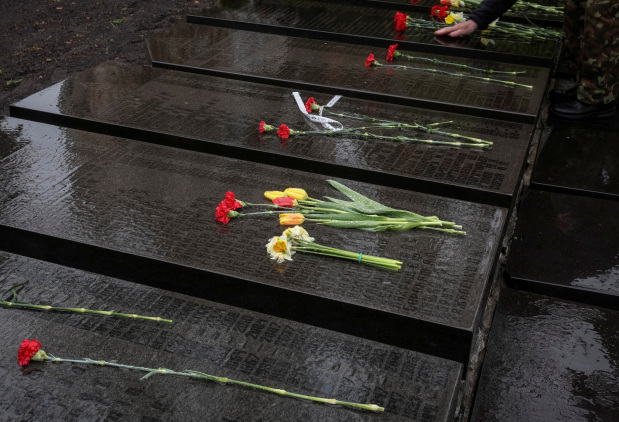
KYIV - Ukraine is commemorating the 40th anniversary of the Chornobyl disaster on Sunday, amid fears that Russia's four-year war could spark a repeat of the world's worst nuclear accident that led to thousands of deaths and devastating environmental consequences.
Kyiv says Moscow has repeatedly sent missiles and drones on a flight path near the plant to attack Ukrainian cities, even damaging a critical protective shield in an attack last year.
Marking the disaster, which spewed radioactive material across much of Europe as Soviet authorities sought to hide its true scale, has taken on sharp new meaning during Russia's invasion of its smaller neighbour.
Foreign officials, including the EU energy commissioner, arrived in Kyiv to commemorate the event and pledge fresh support for Ukraine's power system, which is regularly targeted by Russian air strikes.
Sombre ceremonies took place at a Kyiv memorial honouring fallen first responders, as well as in the purpose-built city of Slavutych in northern Ukraine for evacuated plant employees.
"Chornobyl has become both a symbol of the criminal irresponsibility of the Soviet totalitarian system and of the heroism of the liquidators who responded to the catastrophe," said Denys Shmyhal, Ukraine's energy minister, on X on Sunday.
"Chornobyl is one of humanity's key lessons. Russia's war against Ukraine has further heightened these risks."
WAR DAMAGE
A Russian drone strike in February 2025 punctured a massive arc installed over part of the Chornobyl plant in 2016 to shield a sarcophagus built in 1986 to cover tons of radioactive debris. No leaks were detected, and workers have patched up the hole.
But the arc needs at least 500 million euros' worth of more extensive repairs to prevent permanent damage, according to the European Bank for Reconstruction and Development, which is helping raise funds for the project.
Speaking in Kyiv on Sunday, International Atomic Energy Agency Director General Rafael Grossi said repairs should start as soon as possible.
Kyiv's top state prosecutor told Reuters that Ukrainian radars had detected at least 92 Russian drones that had flown within a 5-km (3-mile) radius of the shield since June 2024.
Nuclear power has become the backbone of Ukraine's energy system since Russia's 2022 invasion, accounting for around 70% of total power generation, according to state-owned firm Energoatom.
Control of the Russian-occupied Zaporizhzhia Nuclear Power Plant - Europe's largest - is a major sticking point in US-brokered peace negotiations between Kyiv and Moscow.
President Volodymyr Zelenskiy said on Sunday the plant risked a disaster worse than Chornobyl if it was not transferred back to Ukrainian control.
LONG-LASTING CONSEQUENCES
Millions were exposed to radiation, hundreds of thousands forced to flee, and wide swathes of land contaminated after the accidental explosion and resulting meltdown inside reactor four at the Soviet-built Chornobyl plant in the early hours of April 26, 1986.
Thousands have since succumbed to radiation-related illnesses such as cancer, although the total death toll and long-term health effects remain a subject of intense debate.
Pope Leo on Sunday said the Chornobyl disaster had left a mark on humankind's collective conscience, and he urged that atomic power "always be used to support life and peace".
Serhii Balashov, one of those who worked on the clean-up, told Reuters that Soviet authorities sought to cover up the consequences of the accident even among those who had played a critical role in containing it.
"They didn't even acknowledge the link between our illnesses and being in Chornobyl for the clean-up," he said on the sidelines of the memorial ceremony in Kyiv.
Some 100 km north of Kyiv and circled by a 2,600-sq km exclusion zone, the plant - which Reuters visited on Wednesday - is now shrouded in an eerie calm.
National Guardsmen patrol the facility, where around 2,250 employees work in days-long shifts overseeing its gradual decommissioning. The plant's last reactor was shut down in 2000.
The control room for reactor four is now a darkened space of mangled and rusted Soviet-era equipment.
Moose and wild horses roam the area around the plant and the nearby abandoned city of Prypiat, in a sign of how nature has taken over in the absence of humans.
&uuid=(email))