

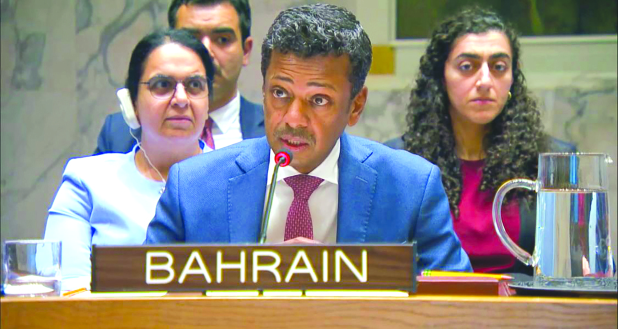
The United Nations Security Council convened an emergency briefing at the request of Bahrain to discuss the terrorist drone attack targeting the perimeter of the Barakah peaceful nuclear power plant in Al Dhafra region of the UAE on Sunday.
The session included a briefing by International Atomic Energy Agency (IAEA) director general Rafael Grossi on the attack and its implications for regional and international peace and security, particularly nuclear safety and security.
Bahrain’s Permanent Representative to the United Nations in New York Ambassador Jamal Al Rowaiei delivered the kingdom’s statement in which it strongly condemned the attack, describing it as a dangerous and unjustified escalation, a flagrant violation of the UN Charter, including Article 2 (4), and a breach of UN Security Council Resolution 2817 (2026).
It stressed that the attack posed a direct threat to international nuclear safety principles related to the protection of peaceful nuclear facilities.
The statement reaffirmed Bahrain’s full solidarity with the UAE, emphasising that the UAE’s security is an integral part of GCC security. It also reiterated Bahrain’s condemnation of drone attacks targeting Saudi Arabia on Sunday.
It praised the UAE authorities for their transparency and swift co-ordination with the IAEA and GCC states, noting that no abnormal radiation levels had been detected. UAE authorities confirmed that two drones were intercepted, while a third struck an electricity generator outside the plant’s inner security perimeter, causing a fire that was quickly contained without affecting the reactors or nuclear safety systems.
The statement also expressed deep concern over the inconsistency within the international community, noting that attacks against civilian infrastructure and peaceful nuclear facilities in the Gulf were taking place while the Nuclear Non-Proliferation Treaty (NPT) Review Conference was underway and amid calls by some parties to uphold nuclear safety standards.
It further highlighted a series of Iranian attacks targeting GCC countries and Jordan since February 28, including attacks on civilian infrastructure, energy facilities, and international maritime routes. It warned that the escalating pattern of attacks threatens regional stability, global energy security, and international supply chains.
The statement also referred to the April 5 attack on the Gulf Petrochemical Industries Company (GPIC) facility in Bahrain, including the targeting of an ammonia tank, warning that the incident could have caused catastrophic human and environmental consequences without preventive measures taken by Bahraini authorities.
It reaffirmed the inherent right of GCC states to self-defence under Article 51 of the UN Charter and called on the Security Council and the international community to take a firm and clear stance to protect civilian and peaceful nuclear facilities, prevent further attacks, and safeguard regional and international peace and security.
&uuid=(email))